10 Tricks and Tips to Save Money on Auto Insurance | Tricks and Tips for Life
10 Tricks and Tips to Save Money on Auto Insurance | Tricks and Tips for Life
Lower your car insurance bill with these 10 tricks and tips: compare quotes, raise deductibles, bundle policies, and unlock hidden discounts today.
Home » Article » 10 Tricks And Tips Save Money On Auto Insurance10 Tricks and Tips to Save Money on Auto Insurance
Optimize Your Auto Insurance Policy with These Money Saving Tricks
Lowering your vehicle insurance premium does not have to be a difficult endeavor, but it does need a planned strategy. Begin by looking around and comparing estimates from at least three different insurance providers; premiums fluctuate greatly since each insurer considers your ZIP code, driving history, and car type differently. Aside from comparing providers, you may rapidly cut your rates by reviewing your existing coverage. Consider removing collision or comprehensive coverage for older vehicles worth less than your deductible. Additionally, increasing your deductible from $250 to $500 or $1,000 will considerably reduce your monthly expenses. Finally, remember to record a shorter daily commute or a shift to remote work, as reduced yearly mileage sometimes qualifies you for significant low-mileage savings.
1. Shop Around and Compare Quotes
One of the most efficient strategies to save money is to compare quotes from several insurance. Even for the same coverage, rates can vary dramatically, so shopping about or utilizing internet comparison tools can save you hundreds of dollars each year. Switching carriers when a better offer is available is usually the simplest method to lower rates.
2. Adjust Your Coverage
- Drop unneeded coverage:
If your automobile is older or has a low value, consider dropping collision or comprehensive coverage, which can significantly reduce your rate. - Keep only what you need:
If your car is still under warranty, avoid paying for additional services such as roadside assistance. - Review the liability limits:
Ensure that your plan provides enough protection without overpaying for high limits.
3. Raise Your Deductibles
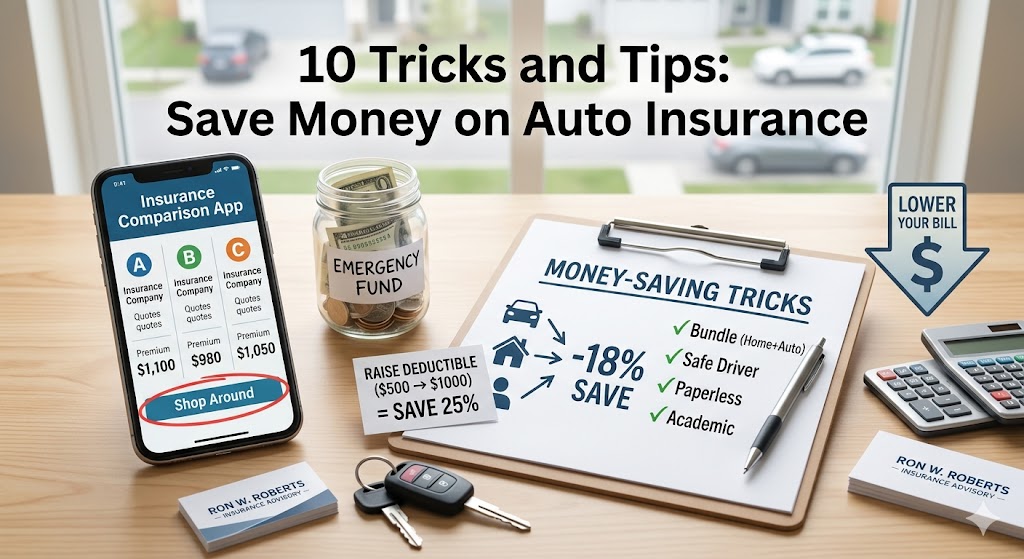
Increasing your collision and comprehensive deductibles can lower your premiums. For example, increasing your deductible from $500 to $1,000 might cut your payment by 25% or more, depending on your insurer. This works best if you have an emergency fund to cover possible out-of-pocket expenses.
Advertisement
4. Take Advantage of Discounts
Insurance companies offer a variety of discounts:
- Multi-policy discounts:
Combining car, house, renters, or life insurance can result in savings ranging from 5 to 18%. - Professional or membership discounts:
Teachers, nurses, military personnel, and select alumni groups may be eligible for 2-10% off. - Payment and paperless discounts:
Paying annually, going paperless, or utilizing automated payments can result in savings of up to 10%. - Safe driver and low-mileage discounts:
Safe driver and low-mileage discounts can be obtained by maintaining a clean driving record or using usage-based insurance packages.
5. Maintain a Good Credit Score
Some insurers use credit history to calculate rates. Improving your credit score might result in cheaper premiums, particularly on full-coverage plans.
6. Regularly Review Your Policy
Moving, purchasing a new car, or changing your driving habits can all have an impact on your insurance costs. Review your insurance once a year to ensure you're not paying too much and to take advantage of any new reductions.
Advertisement
7. How to Implement Savings (Step-by-Step)
- Gather current policy details (limits, deductibles, VIN, annual miles).
- Get 3+ quotes for the same coverage levels; include local/regional carriers.
- List applicable discounts and confirm them with each insurer.
- If switching, time it at renewal to avoid lapse and preserve continuous-coverage discounts.
8. Key Considerations and Decision Points
- How long do you keep cars? (affects whether to drop collision/comprehensive) If you drop collision/comprehensive, your savings will vary depending on the age of the vehicle. The risk, however, is a loss of coverage for repairs/total loss of older cars with low value.
- How much emergency cash do you have? (determines safe deductible increases) If you raise the deductible you can save 10%-30%, this is best for drivers with emergency savings. The risk however is a higher out-of-pocket after a claim.
- Annual miles driven and driving patterns? (low-mileage or telematics programs may help) This one is mainly for people who don't drive a lot. Usage-based auto insurance has a low-high savings rate. The risk however is, telematics privacy may raise rates if you are a risky driver. Best suited for low-mileage and safe drivers.
- Any bundled policies or employer/professional affiliations? (may unlock discounts) If you bundle policies, you can save up to 25%, but it gives you less flexibility when switching carriers. This is best for homeowners and/or renters.
9. Risks, Limitations, and Pitfalls
- Raising deductibles reduces premiums but raises the immediate cost of a claim; preserve an emergency fund.
- Avoid modest claims when the out-of-pocket cost is less than the premium increase; numerous claims might cause rates to rise.
- Telematics/privacy trade-offs: Usage-based systems can reduce expenses for safe drivers while sharing driving data.
10. In Conclusion
Drivers may drastically lower their vehicle insurance rates while being adequately protected by combining these tactics, shopping around, modifying coverage, boosting deductibles, bundling plans, and taking advantage of discounts.
Disclaimer, Verify Your Coverage: Always review your specific policy documents and consult with a licensed insurance agent, broker, or qualified financial professional before making any decisions regarding your insurance coverage, premiums, or benefits. The owners of this website assume no liability for actions taken based on the information provided herein.
Related Articles
- 15 Tricks and Tips to Save Money on Life Insurance
- 5 Tricks and Tips to Health Insurance
- Top 10 Tricks and Tips to Lower Your Insurance
Advertisement
10 Tricks and Tips to Save Money on Auto Insurance | Tricks and Tips for Life
Comments and Questions
Please log in to leave a comment or ask a question. Don't have an account? Register here.