
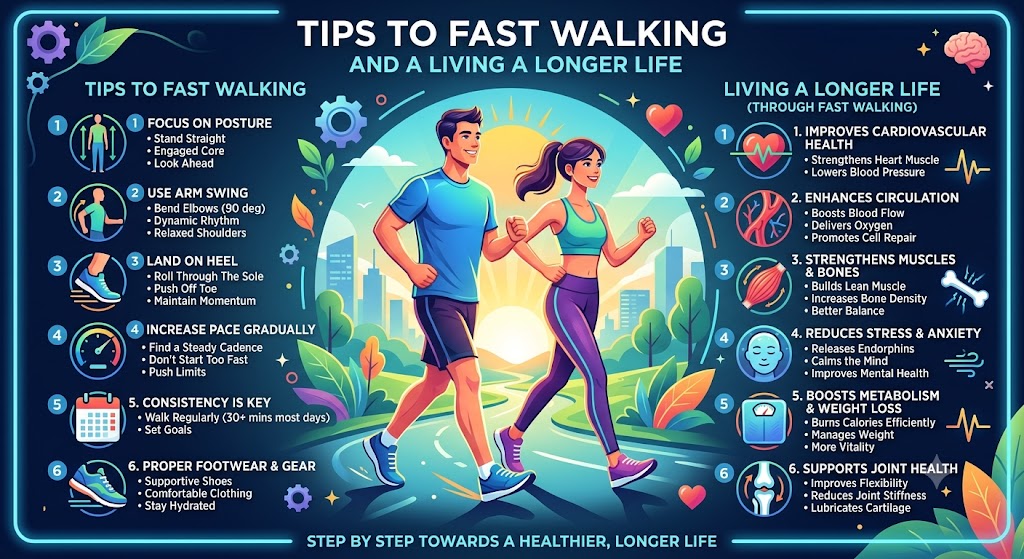
Want to live longer? The secret to a longer life might be your walking pace. Studies show fast walkers live longer. Walking speed linked to a longer lifespan.
Home » Article » Tips To Fast Walking And A Living A Longer LifeDid you know doing something as little as walking faster can lead to a longer lifespan? In this article, you can learn about the surprising link between walking and lifespan. An investigation in the October 2025 issue of the American Journal of Preventive Medicine found that walking quickly for at least 15 minutes each day can significantly reduce the chance of dying young.
The "Talk Test": Your capacity to carry on a conversation without singing is a straightforward sign of how fast you are walking. The "Talk Test" is an equipment-free, scientifically confirmed technique that uses your breathing and speech patterns to gauge the relative intensity of an activity. You can measure your cardiovascular exertion without the need for pricey fitness devices because it closely connects with your heart rate and respiratory thresholds.
Your ability to speak during cardiorespiratory activities generally falls into three distinct training zones:
Low Intensity (Light Effort): You can sing and converse with ease. Your heart rate stays well below its training levels because your breathing is calm and easy.
Moderate Intensity (Brisk Effort): Talking is comfortable, while singing is not. You can still talk in whole, coherent phrases without gasping for oxygen, even though your breathing is substantially heavier. This is the perfect area for quick walks that increase lifespan.
Vigorous Intensity (High Effort): Only a few choppy syllables can be spoken at once. Your body's ventilatory threshold has been exceeded, necessitating frequent breathing pauses.
Your muscles need more oxygen when you exercise, which results in an increase in carbon dioxide (CO2). Your brain pushes your lungs to breathe deeper and quicker in order to release this extra gas. It is mechanically difficult to maintain vocalization, such as singing, without running out of air after the buildup of CO2 exceeds a specific level (the ventilatory threshold), at which point your body prioritizes breathing above speaking.
Establish your baseline: By reciting a brief word or sentence aloud while moving at your typical, leisurely speed.
Accelerate: Increase your walking pace gradually until your breathing becomes more profound.
Try humming or singing a basic song to test your speech. You are moving too slowly if you can still sing with ease.
Set the pace: Accelerate until your breathing pattern makes singing too challenging, but you are still able to say a whole phrase to a friend with assurance. This indicates that you have entered the ideal zone for moderate-intensity exercise.
Advertisement
 Hosting Renewal Goal: $0 / $400 raised, updated daily.
The American Journal of Preventive Medicine released a research from Vanderbilt University Medical Center that offers novel insights into the relationship between physical exercise intensity and lifespan. The study, which examined health data from 79,856 patients monitored over a median of 16.7 years and was led by academics Drs. Lili Liu and Wei Zheng, confirmed that quick walking for only 15 minutes a day reduces the risk of all-cause mortality by over 20%.
This study is particularly noteworthy since it compares walking speeds directly and focuses on addressing public health inequities.
The study directly compared short bursts of intense effort against hours of casual movement, demonstrating that intensity outweighs time:
Fast Walking: Exercising at a brisk pace for just 15 minutes a day led to a 20% reduction in total mortality.
Slow Walking: Conversely, walking slowly (e.g., strolling, light movement around the house or dog walking) for more than 3 hours a day only yielded a minor 4% reduction in mortality risk.
The preventive effects of a fast pace were especially noticeable for cardiovascular illnesses, even though the 20% risk reduction applied to all-cause mortality. According to the researchers, walking quickly increases cardiac output, dilates blood vessels, and actively lowers risk factors including excessive cholesterol, obesity, and hypertension by physically forcing the heart to pump more effectively.
Research on lifespan has traditionally concentrated on affluent, white populations. Using data from the Southern Community Cohort Study (SCCS), the Vanderbilt study examined a population that was mostly from low-income neighborhoods in 12 southeastern states and was made up of 66% Black and 30% white people.
The Takeaway: The 20% mortality reduction held strong regardless of other lifestyle factors (like diet or overall leisure-time exercise).
The Health Impact: The authors highlighted fast walking as a highly accessible, zero-cost clinical strategy to combat systemic health disparities in underserved communities.
It's interesting to note that, in comparison to their counterparts who were usually healthy, those with baseline comorbidities, pre-existing medical conditions, saw even greater risk reductions from rapid walking. All individuals, regardless of age or level of activity, benefited from longevity, nevertheless.
Advertisement
Hosting Renewal Goal: $0 / $400 raised, updated daily.
Regardless of body mass index (BMI), studies on middle-aged individuals have found that brisk walking is associated with higher life expectancies, with fast walkers experiencing life expectancies as high as the late 80s.
Cardiovascular Efficiency: Maintaining a faster pace allows your blood vessels to relax and dilate, lowering cholesterol and cardiac strain.
Low-Cost Habit: It is one of the most accessible forms of vigorous-to-moderate exercise, making it a sustainable habit.
Systemic Impact: Brisk walking increases heart rate, improves insulin sensitivity, and enhances overall metabolic health.
The Science of Aging: How to Live Longer and Better
We're living longer than ever before - but are we living better? In the final episode of this four-part series, David Rubenstein explores the science of aging; from groundbreaking research on longevity to why lifestyle matters more than genetics and how meaningful relationships can add years to our lives. Rubenstein speaks with leading scientists and researchers in the field and uncovers what it truly takes to live not just a long life, but a healthy and fulfilling one.
Disclaimer: The information provided on this website is for educational and informational purposes only and is not intended as medical advice. Always consult a qualified healthcare professional before making any changes to your diet, exercise routine, or health regimen. Reliance on any information provided on this site is solely at your own risk.
Advertisement

Tips to Fast Walking and Living a Longer Life | Tricks and Tips for Life
Comments and Questions
Please log in to leave a comment or ask a question. Don't have an account? Register here.