
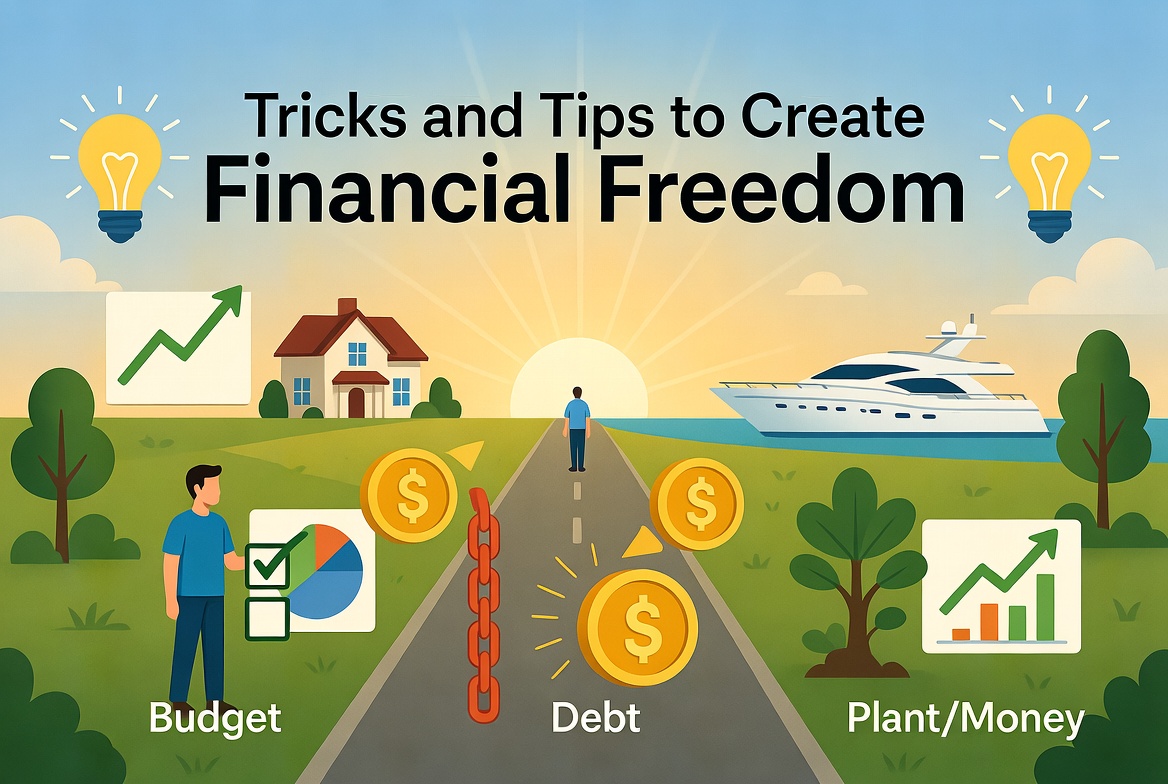
If you want financial freedom, start by setting up a budget, getting out of debt, and investing in dividend stocks to build lasting wealth.
Home » Article » Tricks And Tips To Financial FreedomIf you don't make or have a lot of money available for investing, the first thing you will need to do is set up a budget and then get out of debt. The biggest enemy to anybody's financial freedom is debt. In addition, you should have an emergency fund. Please read our Tricks and Tips to Create An Emergency Fund page.
The idea is to get companies to pay you money, not for you to pay companies money, like paying interest on a loan. You might be asking yourself, how do I get companies to pay me money? The easiest way to get companies to pay you money is to own stock in companies that pay what is called a dividend. Dividends come in all ranges and sizes. The higher the dividend, the higher the risk that stock will be. If you're young and have plenty of time before retiring, you can risk more than somebody that is ready for retirement.
There are several types of investments you can make. Not all investment types pay a dividend. When you are looking at an investment, you need to make sure it's paying a dividend if that's what you desire. I personally love stocks that pay dividends. The list below contains some types of investments that can be found on the stock market.
Investment types include stocks (company ownership), bonds (lending to issuers), cash equivalents (safe, liquid accounts), real estate (via REITS), and mutual funds/ETFs (diversified pools). Key options also include cryptocurrencies, commodities, and derivatives. Risk and return potential range from low-risk, low-return cash accounts to high-risk, high-return stocks.
Advertisement
 Hosting Renewal Goal: $0 / $400 raised, updated daily.
Before investing, consider your risk tolerance, financial goals, and the potential for loss.
Advertisement
Hosting Renewal Goal: $0 / $400 raised, updated daily.
Risk Disclosure: All investments discussed on this site are speculative and carry risk, including the potential loss of principal. Past performance is not indicative of future results. Consult a licensed financial advisor before making any investment decisions.
Now that you know that there's a multitude of ways of investing, investing is one of the few ways to gain financial freedom. As you know, I love dividend stocks, but there are other ways to gain assets. You can also buy other types of investments that don't pay a dividend.
BNDI (Neos Enhanced Income Aggregate Bond ETF) The investment seeks to generate monthly income in a tax efficient manner. The fund is an actively-managed ETF that seeks to achieve its investment objective by (i) investing 80% or more of its assets in bonds or ETFs that invest 80% or more of their assets in bonds and forwards, options or futures contracts related to bonds and seek to obtain exposure to the performance of the U.S.
GOVZ (Ishares 25+ Year Treasury Strips Bond ETF) The investment seeks to track the investment results of the ICE BofA Long US Treasury Principal STRIPS Index composed of the principal payments of U.S. Treasury bonds (specifically principal STRIPS, also known as Separate Trading of Registered Interest and Principal of Securities) with remaining maturities of at least 25 years. The fund will invest at least 80% of its assets in the component securities of the index, and the fund will invest at least 90% of its assets in U.S.
DX (Dynex Capital, Inc.) is a financial services company. The Company is an internally managed mortgage real estate investment trust (REIT), which invests in mortgage-backed securities (MBS). It finances its investments principally with repurchase agreements. Its objective is to provide attractive risk-adjusted returns to its shareholders over the long term that are reflective of a leveraged, high-quality fixed income portfolio with a focus on capital preservation.
GLTR (Abrdn Physical Precious Metals Basket Shares ETF) The investment seeks to reflect the performance of the price of physical gold, silver, platinum, and palladium in the proportions held by the Trust, less the Trust's expenses.
PLUG (Plug Power Inc.) is engaged in providing an end-to-end hydrogen ecosystem, from production, storage, and delivery to energy generation.
Disclaimer, Due Diligence Required: Financial markets, tax laws, and economic regulations change frequently and vary by jurisdiction. You should always perform your own independent research, complete thorough due diligence, and consult with a licensed financial advisor, certified public accountant (CPA), or legal professional before making any financial decisions or putting capital at risk. The owners and publishers of this website assume no liability for any financial losses or damages resulting from the use of this information.
Advertisement

Tricks and Tips to Financial Freedom | Tricks and Tips for Life
Comments and Questions
Please log in to leave a comment or ask a question. Don't have an account? Register here.