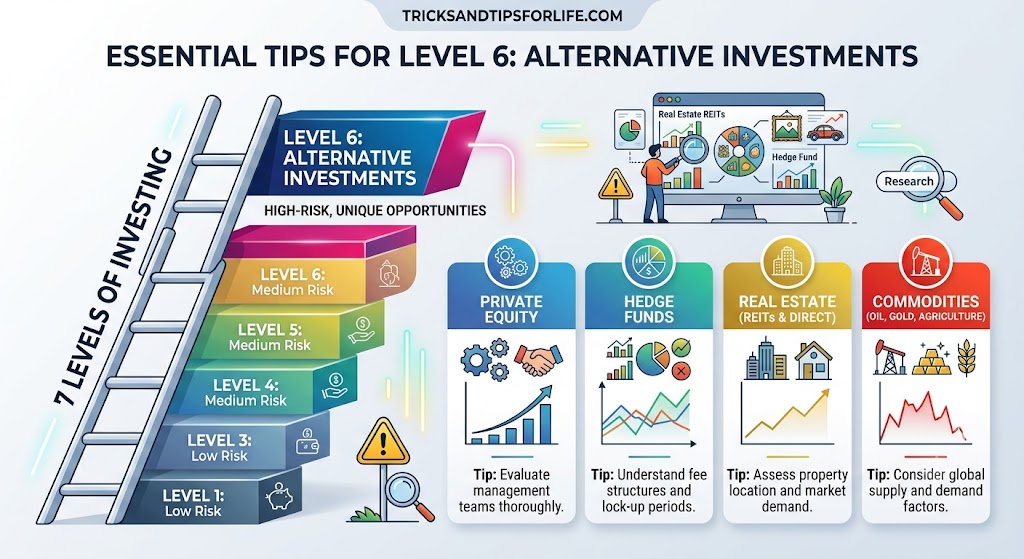
Level 6 of 7 Alternative Investments (high risk) | Tips for 7 Levels of Investing from Low to High Risk | Tricks and Tips for Life
Level 6 of 7 Alternative Investments (high risk) | Tips for 7 Levels of Investing from Low to High Risk
Master Level 6 of the investing risk framework. Get practical tips on safely incorporating high-risk alternative assets into your portfolio strategy.
Home » Article » Tips For 7 Levels Of Investing From Low To High Risk » Level 6 Of 7 Alternative InvestmentsLevel 6 of 7 Alternative Investments (high risk)
Commodities, precious metals, private equity, hedge funds, P2P lending
Alternative investments include any financial asset that does not fall into the usual categories of stocks, bonds, or cash. This wide category encompasses both physical goods like gold, oil, and agricultural commodities, as well as digital assets like cryptocurrencies. It also addresses complicated financial institutions such as hedge funds, private equity, venture capital, and physical collectibles like fine art and rare wine. Historically, these assets were reserved solely for institutional investors and high-net-worth people. Modern financial platforms and fractional investment, on the other hand, have democratized the field, allowing ordinary investors to obtain exposure to niche market sectors that operate outside the traditional stock and bond markets.
The major benefit of alternative investing is diversity. Because alternatives frequently have a poor connection with traditional markets, they might be a great buffer when the stock market falls. For example, gold has historically served as a dependable safe haven during economic downturns. However, the potential for enormous return comes with significant trade-offs. Many alternatives are illiquid, which means they cannot be readily or rapidly sold for cash without incurring a considerable loss of value. They also face significant valuation complexity, little regulatory monitoring, and costly management costs. For these reasons, financial professionals usually see alternatives as high-risk, speculative investments that should account for just a tiny, tactical portion of a well-balanced portfolio.
7 Tips for Alternative Investments
- Use these as diversifiers, they often move differently from stocks and bonds.
- Treat gold and commodities as inflation hedges, but expect real volatility.
- Keep alternatives a small slice of your overall portfolio.
- Watch for high fees, lockup periods, and limited liquidity.
- Do extra due diligence, many of these are less regulated and less transparent.
- Check minimums and eligibility; some require "accredited investor" status.
- Make sure you understand exactly how the investment makes money before committing.
Advertisement
This is where you leave the mainstream behind. Everything up to Level 5 incorporates familiar, regulated, and widely accessible marketplaces. "Alternatives" is a catch-all for items that fall outside the normal stock-bond-real-estate world, and the increase in risk comes from a cluster of structural problems that the preceding levels generally spared you:
Illiquidity and lockups many options (private equity, hedge funds) lock up your money for years, with no ability to get out early if necessary.
Limited regulation and transparency they are generally not subject to the same disclosure laws as public markets, making it more difficult to determine what you actually own and how much it is worth.
High fees arrangements such as "2 and 20" (a 2% yearly charge plus 20% of earnings) significantly reduce profitability.
Complexity many of these earn money in ways that are difficult to grasp, which poses a danger in and of itself.
Access obstacles exist because authorities deem them hazardous. Some need "accredited investor" status (minimum income or net worth).
As always, the category covers a wide range depending on what you hold:
Precious metals and commodities (gold, silver, and oil) are on the lower-to-middle edge, volatile yet liquid and easy to purchase. Gold is commonly used as an inflation and crisis hedge.
P2P lending falls somewhere in the center, with stable revenue potential but significant default risk and little liquidity.
Private equity and hedge funds are on the cutting edge, potentially large profits, but illiquid, opaque, pricey, and restricted to qualified investors.
Despite this, investors come here for diversification: alternatives frequently move independently of stocks and bonds, so a tiny investment may smooth out a portfolio's overall ride and occasionally buffer against factors (such as inflation) that harm mainstream levels.
One element to consider: what distinguishes Level 6 from Level 7 isn't simply the likelihood of loss, it's the type of it. Alternatives are dangerous mostly because they are complicated, illiquid, and opaque, rather than because they are pure gambles. That's why the typical recommendation is to retain them as a tiny portion of your portfolio, enough to benefit from diversity but not enough to drown you if one of them locks up or fails.
Continue to the Next Rung of the Ladder
Investing (Level 7 of 7): Speculative Investments
Disclaimer, Due Diligence Required: Financial markets, tax laws, and economic regulations change frequently and vary by jurisdiction. You should always perform your own independent research, complete thorough due diligence, and consult with a licensed financial advisor, certified public accountant (CPA), or legal professional before making any financial decisions or putting capital at risk. The owners and publishers of this website assume no liability for any financial losses or damages resulting from the use of this information.
Related Articles:
- 16 Tricks and Tips for Living Within Your Means
- Tips for 7 Levels of Investing from Low to High Risk
- Top 15 Tricks and Tips to Saving Money on Food Away From Home
- Top 10 Tricks and Tips to Save Money on Loans
- Top 10 Common Forgotten Expenses
- Tricks and Tips to Create Financial Freedom
- Tricks and Tips to Create an Emergency Fund
- Tricks and Tips to Get Out of Debt
- Tips to Setting Up Your Budget
Advertisement
Level 6 of 7 Alternative Investments (high risk) | Tips for 7 Levels of Investing from Low to High Risk | Tricks and Tips for Life
Comments and Questions
Please log in to leave a comment or ask a question. Don't have an account? Register here.