Budgeting for Beginners | Tricks and Tips for Life
Budgeting for Beginners | Tricks and Tips for Life
Master your money with this simple budget guide for beginners. Learn how to start budgeting using the 50/30/20 rule, easy tools, and avoid common mistakes
Home » Article » No Fail Budgeting Guide » Budget For BeginnersBudgeting for Beginners
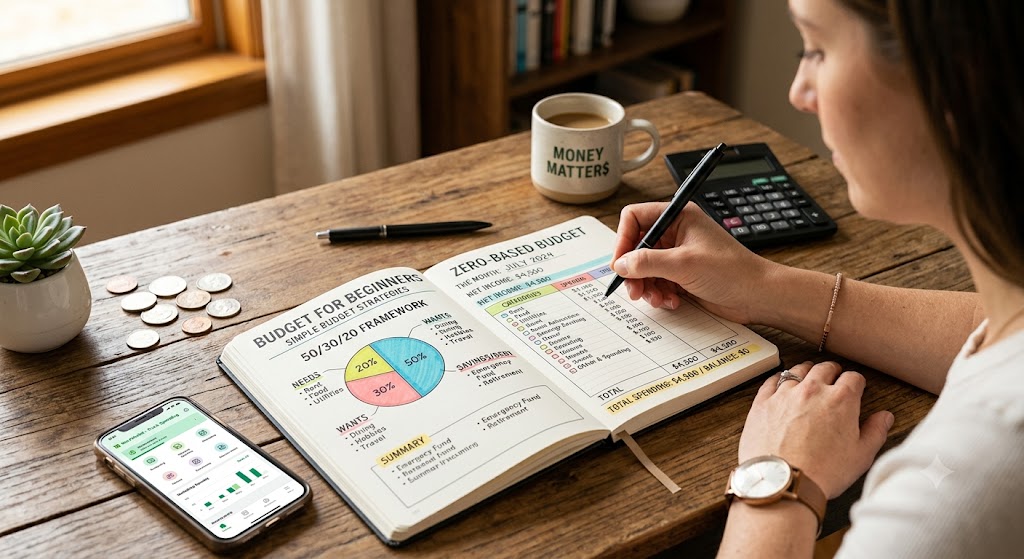
In order to build your first budget, you will need a few things. First, you will need to know what your total monthly income is, take-home after taxes. Second, you will need to know what your monthly expenses are; these include everything you spend money on, like rent, utilities, food, entertainment, and automotive. A great starting point here would be to use the 50/30/20 rule. This rule basically is as follows: 50% for your needs, 30% for your wants, and 20% for savings and debt repayment.
How to Start Budgeting The most successful method to manage your finances is to begin with a simple strategy, track everything relating to your money and where it goes, and then employ the proper tools.
By taking this technique, you may construct a unique financial roadmap that replaces guessing with deliberate preparation. Instead of feeling confined, this organized visibility gives you confidence by allowing you to discover spending trends, prioritize critical purchases, and pay off unneeded debt. Finally, consistent budgeting provides a solid foundation for future goals—whether they are to build an emergency fund, invest for retirement, or enjoy worry-free discretionary spending—because it gives you complete control over where your money goes and how it works for you.
1. The 50/30/20 Framework
While it can be overwhelming to track every single penny, this popular rule assigns a broad limit to your spending.
50% For Your Needs: these are the fixed costs of what you must pay to live. These include items such as mortgages or rent, utilities, minimum debt payments, groceries, and insurance.
30% For Your Wants: this portion is dedicated to discretionary spending on things that you enjoy doing. They include things like dining out, subscriptions, hobbies, and vacations.
20% For Your Savings and Debts: This is money allocated to an emergency fund, retirement account, and extra debt payments.
To put this framework into action, first calculate your net income, which is your take-home pay after taxes and automated deductions. From there, check your monthly bank statements to determine where your money is currently going, and don't be concerned if your numbers don't immediately correspond. The 50/30/20 rule's charm lies in its flexibility; it serves as a financial guardrail rather than a tight prison. If your "needs" are greater because you live in a high-cost-of-living place, you can temporarily reduce your "wants" to keep your financial situation stable while you adjust.
The fundamental benefit of this approach is its capacity to minimize "budgeting guilt" while promoting long-term stability. By setting aside 30% for your needs, you give yourself permission to spend your hard-earned money today without jeopardizing your future. Meanwhile, routinely automating the last 20% for savings and debt means that you are quietly developing a strong safety net and compounding wealth in the background. Finally, it switches your perspective from tiresome cost tracking to big-picture cash flow management, turning budgeting from a job to a tool for personal freedom.
2. Zero-Based Budgeting
Alternatively, zero-based budgeting indicates that your income minus your expenses equals zero. Each dollar of your take-home income is allocated to a job at the beginning of each month. If you have $200, for example, left over after paying your expenses, you cheerfully transfer it into your savings account, investment accounts, or apply it to debts; this ensures that nothing goes unaccounted for. Remember, the whole goal here is to account for every penny you spend.
To make zero-based budgeting effective, you must become proactive rather than reactive with your money. At the beginning of each month, you write down your estimated net income and plan out exactly where each dollar will go before spending it. This entails allocating a "job" to each category, from set bills and groceries to fun money and savings goals, until your total income minus total scheduled costs equals precisely zero. Because no two months are the same, you will alter these allocations regularly to account for seasonal changes, such as Christmas shopping, yearly insurance payments, or summer travel.
The genius of this strategy is that it pushes you to make deliberate, purposeful trade-offs rather than allowing your money to float away. When you give every dollar a purpose, you eliminate the mystery of "missing" cash at the end of the month and put an end to thoughtless, impulsive purchases. It also eliminates the shame of discretionary spending; if you've set aside $100 for eating out, you may spend it with perfect confidence knowing your savings, expenses, and future objectives have all been met. Ultimately, zero-based budgeting changes your relationship with money from a passive spectator sport to an active, empowered approach in which you have complete control over your financial future.
Advertisement
3. Recommended Tools
You do not need a PhD in accounting to track your finances. Start with simple tools.
Simple List/Spreadsheet: write your take home pay at the top of a piece of paper or use simple tools like NerdWallet budgeting worksheets.
Budgeting Apps: apps like NerdWallet or EveryDollar automatically link to your bank accounts and categorize your purchases.
The finest budgeting tool is the one that you will really use. When determining where to begin, choose a tool that matches your unique style and level of comfort. If you like a hands-on, highly visible method in which you feel linked to every transaction, starting with a real notepad or a simple Excel template is frequently the most satisfying option. If you want to reduce manual effort and save time, automated budgeting tools are the way to go. Do not allow "tool fatigue" to hold you back—begin with the simplest choice available, and remember that you can always upgrade to a more complex system when your spending habits become automatic.
These technologies handle the difficult labor of converting abstract data into visual, practical realities. They serve as an early warning system, flagging excess before it harms your financial goals. Instead of worrying about intricate calculations, a good tool gives you instant, clear pictures of your remaining balance, allowing you to make rapid, guilt-free purchasing decisions on the go. Finally, they bridge the gap between your financial aspirations and your real daily behaviors, changing budgeting from a tedious administrative task to an easy element of your routine.
4. Additional Items
Set Realistic Goals: Set realistic goals and tails determining how much you need, why it matters, and when you intend to attend to it. Breaking down large goals into smaller, bite sized monthly targets reduces mental fatigue and transforms abstract dreams into a step-by-step financial strategy.
Automated Savings: As I discussed in the previous article, you set up automatic transfers to your savings account, retirement accounts, and debt repayments to pay yourself first.
Review and Adjust: As discussed in the previous article, you simply check your weekly or monthly budget and tweak the amounts of your income and expenses as they change.
Advertisement
5. Common Beginner Mistakes to Avoid
a. Budgeting on your gross income, not your net / take home pay.
b. Ignoring irregular expenses or variable income.
c. Making your budget too complex; keep it simple.
d. Not tracking your actual spending before you hit your spending limits.
Why These Pitfalls Happen
These early missteps usually stem from a place of high enthusiasm but low predictability. For instance, planning a budget around your gross (pre-tax) salary leaves you with a massive cash deficit once taxes, healthcare, and automatic retirement contributions are actually deducted. Similarly, treating every month as if it has identical expenses ignores the reality of seasonal costs—like car registration, annual subscription renewals, or holiday gifts—which can easily derail a rigid plan. To bypass these traps, you must base your budget entirely on the actual deposits landing in your bank account, keep your categories broad and simple, and build a small "miscellaneous" buffer to absorb the irregular expenses that inevitably pop up.
How Avoiding Them Empowers You
Sidestepping these beginner blunders shifts your budget from a theoretical fantasy into a highly resilient, real-world tool. When you budget with accurate net numbers and plan for irregular expenses ahead of time, you completely eliminate the sudden panic of unexpected bills and the frustrating cycle of abandoning your budget because "it just doesn't work." Instead of feeling restricted by a complex, rigid system, you gain absolute clarity on your true spending power. Ultimately, avoiding these traps builds immediate confidence, transforming your budget from a stressful chore into a highly reliable blueprint for your daily peace of mind.
Pro Tip: Keep it simple and start small; simply log every expenditure for the month and then allocate the amounts from the items that you have spent money on in these categories. Over time, you will acquire clarity and confidence in handling your finances.
Back to No Fail Budgeting Guide category page to read more.
Disclaimer, Due Diligence Required: Financial markets, tax laws, and economic regulations change frequently and vary by jurisdiction. You should always perform your own independent research, complete thorough due diligence, and consult with a licensed financial advisor, certified public accountant (CPA), or legal professional before making any financial decisions or putting capital at risk. The owners and publishers of this website assume no liability for any financial losses or damages resulting from the use of this information.
Related Articles
- 16 Tricks and Tips for Living Within Your Means
- Tips for 7 Levels of Investing from Low to High Risk
- Top 15 Tricks and Tips to Saving Money on Food Away From Home
- Top 10 Tricks and Tips to Save Money on Loans
- Top 10 Common Forgotten Expenses
- Tricks and Tips to Create Financial Freedom
- Tricks and Tips to Create an Emergency Fund
- Tricks and Tips to Get Out of Debt
- Tips to Setting Up Your Budget
Advertisement
Budgeting for Beginners | Tricks and Tips for Life
Comments and Questions
Please log in to leave a comment or ask a question. Don't have an account? Register here.