Mastering Your Daily Financial Defense | Tricks and Tips for Life
Mastering Your Daily Financial Defense | Tricks and Tips for Life
Build a rock-solid financial foundation before you invest. Learn how to stop financial bleeding, eliminate debt, budget effectively, and protect your wealth.
Home » Article » No Fail Budgeting Guide » Mastering Your Daily Financial DefenseMastering Your Daily Financial Defense
When it comes to investing you must first establish a financial foundation before you invest. Because without a proper defense, offense can leave you vulnerable.
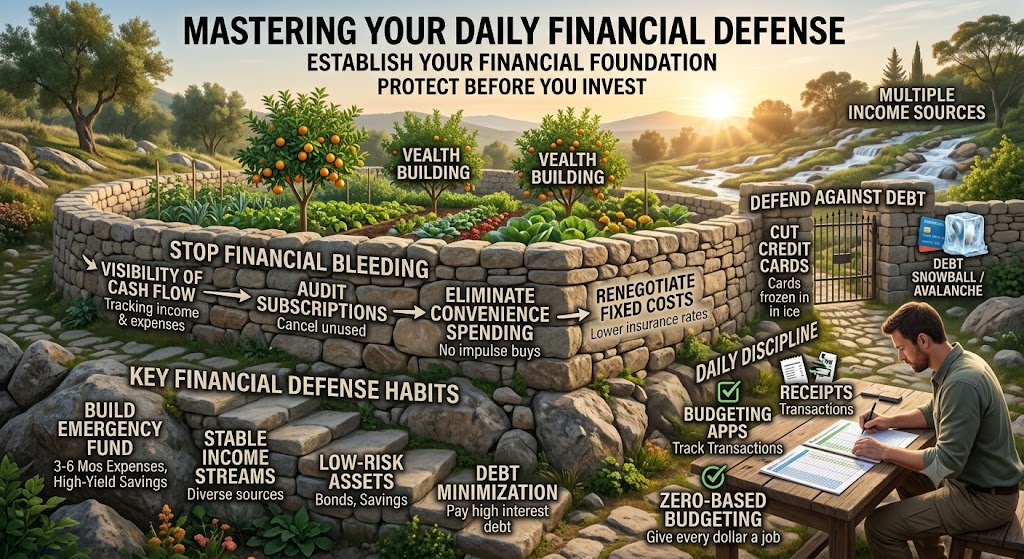
In order to put an end to financial bleeding it is required for you to establish an absolute visibility of your cash flow. This is done by cutting non-essential convenient expenses and putting an end to new debt accumulation. When you master your daily financial defense it sets a strong structural foundation needed to absorb shocks and prepare for the wealth building you desire.
Why Defense Comes First
Defense in financial terms is about protecting your wealth to ensure you can survive unexpected setbacks that may destroy your financial wealth. Reliant on just one single income or investing in one stock alone can destroy your financial wealth. Because, one bad event can knock you off balance so wealth diversification of income sources is essential examples would be rental properties, dividends, royalties, multiple job and holding low risk assets to cover essentials.
Close the Cash Drains
Audit Subscriptions: If you are sincere about your financial well-being you must immediately cancel any unused or duplicate streaming services and memberships.
Eliminate Convenience Spending: Conserving wealth is very important to you so you should also delete store credit cards from all apps like Amazon, DoorDash to avoid functionless and impulse purchases
Renegotiate Fixed Costs: You can also stop financial bleeding by shopping around for better rates on your insurance bills.
Advertisement
Key Financial Defense Habits
Build an Emergency Fund: It is not only recommended but a necessity that beginners build an emergency fund of 3 to 6 months of your living expenses.
Stable Income Streams: Establish stable income streams; by having multiple sources of income, you can save yourself financial turmoil. By having multiple sources of income, if one should fail, your entire finances do not collapse.
Low-Risk Assets: Low-risk assets like bonds, savings accounts, or insurance are a good hedge against volatility.
Debt Minimization: Debt minimization can be done by paying off high interest debt like credit cards to reduce the financial strain on your finances. Debt minimization strategies, such as budgeting, repayment plans, consolidation, or settlement, help lower balances, manage interest, and negotiate terms. Understanding and applying these methods could help you effectively reduce what you owe.
Locking Down Your Budget
Zero-Based Budgeting: Zero-based budgeting gives every dollar you have a job before the month begins by allocating exactly the amount you need for the expenses, savings, and debt, ensuring that the math equals zero. What Is Zero-Based Budgeting (ZBB)? Zero-based budgeting (ZBB) is an intense budgeting approach in which all costs must be justified from a 'zero foundation' for each new period. Unlike traditional budgeting, which often raises previous budgets, ZBB entails examining and justifying each expenditure, with an emphasis on strategic objectives and financial efficiency. ZBB is typically used by businesses to detect and minimize wasteful expenses, but individuals and families may also use it to better their financial decision-making.
Track Transactions: Track your transactions by using apps like Intuit QuickBooks, Simplifi, Empower, and Rocket Money to automate the monitoring of your spending trends in real time. Some of the dollar tracking apps will categorize your transactions automatically, provide visual reports, and even scan receipts for accuracy. These apps can actually be linked to your bank accounts and credit cards for real-time tracking. I personally keep all my receipts and put the amounts into a spreadsheet that is categorized to my normal expenses.
Daily Discipline to Strengthen Defense
Financial discipline is the cornerstone of long-term security. Building daily discipline is about creating systems that make consistent action automatic, even when motivation fades. This “defense” protects you from distractions, procrastination, and self-sabotage, keeping you on track toward your goals.
Pay Yourself First: The pay-yourself-first strategy treats savings like a bill: when your salary arrives, a predefined amount is automatically sent to savings, investments, or retirement accounts before you pay bills or spend. This contradicts the "spend first, save what's left" strategy, which frequently yields little or no savings.
Create and Stick to a budget: creating and sticking to a budget is the cornerstone of financial management. The idea is to plan, track, and adapt so you can prioritize demands, avoid wasteful expenditures, and stay on pace to achieve your objectives. Begin by estimating your net income (after taxes and deductions), taking into account all sources, including salary, side gigs, rental income, and investments. If your income is erratic, take the average of the previous 3-6 months.
Automate Emergency Fund Savings: Automating your Emergency Fund savings means setting up recurring transfers so money moves into your accounts automatically, before you can spend it. This approach removes willpower dependency, ensures consistency, and maximizes compound growth.
Review regularly: Regularly reviewing and adjusting your budget is essential to keep it relevant as your income, expenses, and goals evolve. A static budget can quickly become misaligned with your current financial reality, leading to overspending, under-saving, or missed milestones
Defend Against Debt
Cut the Cards: Place your credit cards in a glass of water and freeze them "literally". If you intend to use your credit card, you must first thaw it. That will give you some time to reconsider if you truly want to make the purchase with your credit card and breach your promise of a credit-card-free month. Or completely eliminate them by cutting up all your credit cards to avoid additional buildup of debt.
Debt Repayment: Choosing between the two comes down to whether you want to increase momentum or cut costs. Both techniques demand making minimum payments on all obligations and directing any additional funds toward a single targeted sum.
Debt Snowball: Pays off the smallest balance first. It delivers immediate psychological gains and consistent motivation as smaller accounts are fully removed.
Debt Avalanche: Pays off debts with the highest interest rates first. It is the mathematically most efficient strategy, reducing total interest paid and the overall time to debt freedom.
Advertisement
Build a Starter Buffer
Starter Emergency Fund: Work toward a starter emergency fund of three to six months of your total expenses to cover unforeseen emergencies without having to rely on high-interest credit cards.
High-Yield Savings: Keep the money in a high-yield savings account (HYSA) to avoid losing buying power due to inflation.
The Offense and Defense Balance
Once your defense is strong, you may pursue chances for expansion, such as investing, launching enterprises, or increasing revenue sources, without worry of losing everything. This equilibrium prevents financial ruin while preparing you for long-term riches
Bottom line
Stop the "financial bleeding" by protecting your foundation first. Even the most aggressive expansion initiatives might fail if they lack a solid defensive basis. Create your defense, then unleash your attack.
Back to No Fail Budgeting Guide category page to read more.
Disclaimer, Due Diligence Required: Financial markets, tax laws, and economic regulations change frequently and vary by jurisdiction. You should always perform your own independent research, complete thorough due diligence, and consult with a licensed financial advisor, certified public accountant (CPA), or legal professional before making any financial decisions or putting capital at risk. The owners and publishers of this website assume no liability for any financial losses or damages resulting from the use of this information.
Related Articles:
- 16 Tricks and Tips for Living Within Your Means
- Tips for 7 Levels of Investing from Low to High Risk
- Top 15 Tricks and Tips to Saving Money on Food Away From Home
- Top 10 Tricks and Tips to Save Money on Loans
- Top 10 Common Forgotten Expenses
- Tricks and Tips to Create Financial Freedom
- Tricks and Tips to Create an Emergency Fund
- Tricks and Tips to Get Out of Debt
- Tips to Setting Up Your Budget
Advertisement
Mastering Your Daily Financial Defense | Tricks and Tips for Life
Comments and Questions
Please log in to leave a comment or ask a question. Don't have an account? Register here.