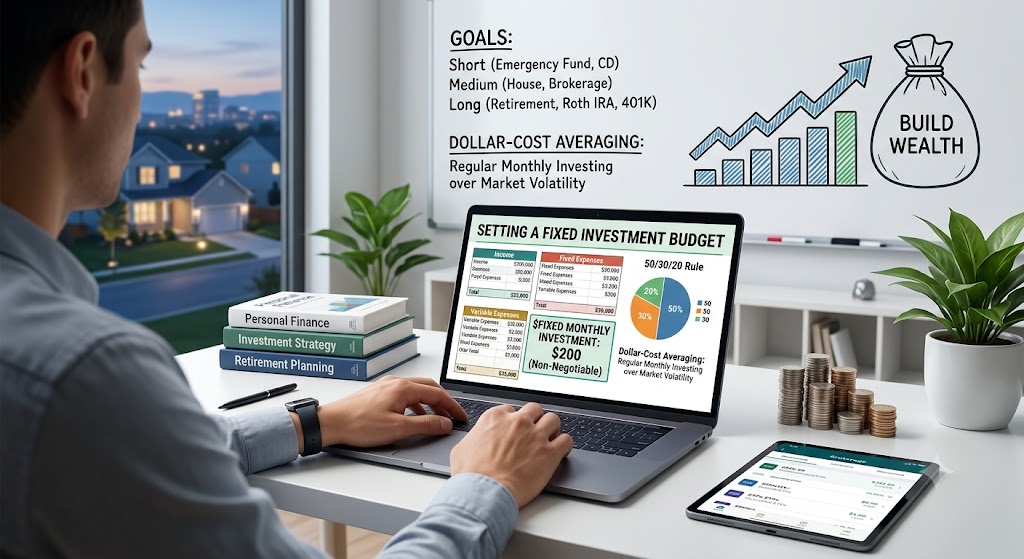
Setting a Fixed Investment Budget | Tricks and Tips for Life
Setting a Fixed Investment Budget | Tricks and Tips for Life
Master your finances by setting a fixed investment budget. Learn to use dollar-cost averaging, prioritize financial goals, and build long-term compounding wealth.
Home » Article » No Fail Budgeting Guide » Set A Fixed Investment BudgetSetting a Fixed Investment Budget
Setting a fixed investment budget entails selecting how much you will invest each month, regardless of market conditions, and adhering to it regularly. This method helps you maintain discipline, avoid emotional decisions, and accumulate wealth over time. Decide how much you can invest each month, including fees. Start small if needed, with $25–$100 each month. Make it a non-negotiable line item in your budget. Choose low-cost, diversified options like ETFs or index funds to fit your risk tolerance. There are user-friendly digital brokerage platforms that make it easy to invest.
Setting a Fixed Investment Budget is essentially a road plan for making the shift from accidental saver to purposeful investment. By creating a set budget, you are utilizing a strong financial concept known as dollar-cost averaging. Instead of attempting to "time the market"—which frequently results in purchasing when prices are high out of excitement or selling when they are low out of fear—you buy more shares when prices are low and fewer shares when prices are high. Over time, this mechanical stability reduces your average cost per share, eliminating the guesswork and turning your emphasis away from short-term market volatility and toward long-term compounding growth.
Define Your Financial Goals
Begin by determining your goals, such as retirement, house ownership, college finance, or emergency savings. Clear goals assist establish how much you need to invest and for what duration. Setting financial goals is the core of every effective investing plan.
Here's how to break down and prioritize objectives.
Classify Your Goals by Timeline
First, you must identify your timeline and your goals. Short-term would be considered zero to two years and is meant for emergency funds, upcoming vacations, or down payments on a car. Medium-term would be from 2 to 10 years; this would be for buying a house or starting a business. Finally, the long-term is an excess of 10 years; this would be for retirement or a child's college education.
Classifying your goals by timeframe is the first step in defining asset allocation—the particular mix of stocks, bonds, and cash used to fund each milestone. The real advantage of this strategy is risk minimization. For example, short-term money should be held in highly stable, liquid vehicles such as high-yield savings accounts or certificates of deposit (CDs), guaranteeing that the capital is safe and available when needed. Medium-term objectives can handle a balanced portfolio of conservative growth assets, but long-term goals have the runway needed to weather stock market volatility in exchange for larger compounding returns. By classifying your goals first, you avoid the risky practice of exposing short-term capital to stock market declines or, conversely, allowing long-term money to stagnate against inflation in a basic bank account.
Qualify the Targets
Qualifying the targets would be the second item you should be concerned about. It consists of calculating your total cost; you need to research the future cost of your goal, factoring in inflation so you end up with the same purchasing power as today. Next, you will need to assign a deadline; this is the exact year that you project. You will need access to the money. Finally, you need to determine your monthly savings to end up with that amount that you have stated to be your goal. To do this, you simply divide the total targeted amount by the number of months available while adjusting for expected investment growth.
Qualifying your targets transform your financial goals from nebulous, abstract dreams to clear, practical numbers. The key advantage of this phase is reality testing. By including inflation adjustments and estimated investment rates early on, you avoid the usual pitfall of underfunding a goal and falling short when the deadline approaches. For example, a nest fund or property down payment that appears enough now would need a greater nominal dollar amount 10 years from now in order to maintain the same purchasing power. When you compute that exact future value and overlay it against your timetable, the mystery dissolves, leaving you with a single, obvious monthly savings goal. This numerical precision eliminates guessing, enabling you to watch your progress with perfect confidence, and quickly determines if you need to change your timeframe or raise your monthly payment to keep on track.
Match Goals to Account Types
For your short-term goals, it is advised to use high-yield savings accounts or certificates of deposit CDs to keep cash safe and accessible. The next account type would be tax-advantaged growth investments; examples would be 401Ks, IRAs, and Roth IRAs for retirement and college savings. Finally, flexible investment accounts are standard taxable brokerage accounts for a medium- to long-term goal without the age withdrawal restrictions. Matching your objectives to the appropriate account types is basically about tax efficiency and regulatory compliance. The essential value of this technique rests in knowing that where you store your investments is as important as what you invest in.
Using tax-advantaged funds like IRAs or 401(k)s allows your money to grow tax-free or tax-deferred, dramatically compounding your long-term wealth. However, these accounts have rigorous IRS withdrawal age requirements (usually age 59½) and early-withdrawal penalties. By strategically balancing these with flexible, taxable brokerage accounts for mid-term goals and liquid, principal-protected accounts for short-term needs, you achieve a double benefit: you aggressively reduce your lifetime tax burden while ensuring you never face steep financial penalties or forced asset liquidations simply to access your own money when a milestone arrives.
Assessing Your Income and Expenses
List all your sources of income, whether it be wages, side gigs, or passive income, as well as your fixed costs and variable costs. Your costs basically are what it costs you to live. By doing so, it will reveal how much you have left to save or invest. Assessing your income and spending is more than just a list; it's an objective diagnostic tool for determining your genuine cash flow—the rate at which money enters and exits your life. The revolutionary impact of this step is that it eliminates financial blind spots.
Many individuals make assumptions about what they can spend, but separating fixed expenditures (such as rent or insurance) from variable costs (such as dining or entertainment) establishes a baseline of reality. This clarity grants you immediate agency. Instead of wondering where your money went at the end of the month, you now have the ability to intentionally channel leakage from variable costs straight toward your wealth-building objectives, transforming passive financial awareness into an active, wealth-generating approach.
Choose a Budgeting Rule
The most popular budgeting frameworks include the 50/30/20 rule, defined by 50% for needs, 30% for wants, and 20% for savings and investments, and the 50/40/10 rule, defined by 50% for needs, 40% for investments, savings, and debt payments, and 10% for discretionary spending. You can adjust these percentages based on your priorities and risk tolerance. Choosing a systematic budgeting guideline transforms your financial situation from a chaotic monthly guessing game to a simplified, predictable process.
The fundamental advantage of using a precise percentage-based framework is that it reduces decision fatigue; it assigns each dollar a predetermined purpose before it reaches your bank account. Instead of constantly analyzing and fretting over every micro-purchase, you stay within clear, macro-level restrictions that prioritize your financial future. For example, establishing a high-investment structure, such as the 50/40/10 rule, encourages an aggressive savings rate by treating investments as a permanent need rather than an afterthought. Finally, these principles provide you the operational flexibility to spend your discretionary money guilt-free, knowing that your basic living expenses are covered and your wealth-building goals are being accomplished.
Advertisement
Decide on the Investment Amount
Simply select the amount you can afford to invest regularly. It should be low enough to sustain your cash flow. But high enough to make a meaningful impact on your goals. You will also need to include any brokerage and other fees in your calculations. Choosing the right investment amount is an exercise in optimization, requiring you to strike a balance between current cash flow stability and long-term asset growth. The practical benefit of determining this particular amount is that it defines the pace—or capital velocity, at which you will march toward your goals.
If you set the amount too high in a fit of fleeting enthusiasm, you risk disturbing your everyday life and causing financial crunches that compel you to prematurely liquidate your portfolio. In contrast, setting it too low out of prudence risks missing out on the market's compounding potential, allowing you to fall short of your final goals. By meticulously factoring in all operating expenses and attaching this amount to your real monthly surplus, you eliminate emotional guessing and establish a long-term, high-impact habit that optimizes your wealth while minimizing financial pressure.
Automate Your Investments
As discussed in previous articles, you need to set up automatic transfers at the start of each month to ensure consistency. This protects you from missing contributions and builds a habit.
Diversify and Rebalance
Spread your investments across asset classes such as stocks, bonds, real estate, and mutual funds to reduce risk. You will also need to periodically rebalance to maintain your target allocation.
Build an Emergency Fund
Before you can start investing heavily, you need to save at least 3 to 6 months of living expenses in an accessible account that is normally high-yield and safe. This protects your investments from unexpected expenses. Because if you do not have the emergency fund, you will end up drawing money from the investments.
Review and Adjust
Revisit your budget periodically to ensure it still aligns with your goals, income changes, and market conditions. By following these steps, you can create a fixed income budget that supports long-term financial health while keeping your investment process simple and constant. Deciding on a methodical procedure for reviewing and adjusting your plan turns your budget from a hard, static document to a dynamic financial roadmap. The fundamental significance of this phase is that it keeps your investing plan relevant when your real-world circumstances change.
Life is seldom static; an unexpected income boost, a change in family dynamics, or structural adjustments in the larger economy will all transform your financial situation. By arranging frequent check-ins—quarterly or annually—you obtain a structured chance to purposefully increase your investing contributions as income grows, or to safely pivot your asset mix as you approach your target dates. This conscious habit of adjustment serves as the ultimate safety valve, ensuring that your money continues to perform efficiently for your present reality while maintaining the fundamental consistency of your long-term goal.
Advertisement
The two listed below are brokerage platforms that I have used in the past; they both do not charge you fees for trades.
Digital Brokerage Platform
1. E-TRADE is a popular, user-friendly digital brokerage platform owned by Morgan Stanley. It provides self-directed investors with tools to trade stocks, mutual funds, ETFs, bonds, and cryptocurrency. E-TRADE offers commission-free online trades for U.S.-listed stocks and ETFs and features multiple platforms suited for both beginners and active traders.
2. Charles Schwab is a major American multinational financial services company. It is one of the largest brokerage firms and banks in the United States, managing over $13 trillion in client assets across roughly 47 million total accounts (including brokerage, banking, and workplace retirement accounts) as of mid-2026. Schwab offers zero-commission online trading for stocks, mutual funds, and ETFs, along with specialized tools for both casual and active investors.
Compare E-Trade with Schwab
While Charles Schwab operates as a full-service financial powerhouse best suited for long-term investors who benefit from its vast research resources, robust retirement planning tools, and integrated fee-free global banking, Morgan Stanley's E-Trade caters heavily to fast-paced, active traders seeking a highly streamlined options and futures interface. E-Trade shines with its acclaimed Power E-Trade platform, which provides exceptional, intuitive tools for executing complex derivative strategies with minimal friction. Schwab, by contrast, focuses on a broader, wealth-management ecosystem that delivers deep fundamental analysis, extensive mutual fund selections, and personal advisory services. Both platforms offer excellent $0-commission stock and ETF trades, meaning your choice ultimately hinges on whether you prefer E-Trade's specialized, trader-centric environment or Schwab's comprehensive, all-in-one financial infrastructure.
In Summary
Setting a defined investing budget transforms you from a passive saver into a deliberate investor by using dollar-cost averaging to remove emotional market timing and lower your average cost per share over time. To put this into practice, start by categorizing your financial goals by timeline (short, medium, and long-term) to guide risk-appropriate asset allocation, then match those goals to the right account types, tax-advantaged or flexible, and use a percentage-based framework, such as the 50/30/20 rule, to keep your cash flow on track. Finally, build a 3- to 6-month emergency fund to protect your capital, automate your monthly contributions into low-cost, diversified funds through a commission-free brokerage like E-Trade or Charles Schwab, and revisit your plan regularly to adapt it as life changes.
Back to No Fail Budgeting Guide category page to read more.
Disclaimer, Due Diligence Required: Financial markets, tax laws, and economic regulations change frequently and vary by jurisdiction. You should always perform your own independent research, complete thorough due diligence, and consult with a licensed financial advisor, certified public accountant (CPA), or legal professional before making any financial decisions or putting capital at risk. The owners and publishers of this website assume no liability for any financial losses or damages resulting from the use of this information.
Related Articles
- 16 Tricks and Tips for Living Within Your Means
- Tips for 7 Levels of Investing from Low to High Risk
- Top 15 Tricks and Tips to Saving Money on Food Away From Home
- Top 10 Tricks and Tips to Save Money on Loans
- Top 10 Common Forgotten Expenses
- Tricks and Tips to Create Financial Freedom
- Tricks and Tips to Create an Emergency Fund
- Tricks and Tips to Get Out of Debt
- Tips to Setting Up Your Budget
Advertisement
Setting a Fixed Investment Budget | Tricks and Tips for Life
Comments and Questions
Please log in to leave a comment or ask a question. Don't have an account? Register here.