Structural Habits for Money and Finances | Tricks and Tips for Life
Structural Habits for Money and Finances | Tricks and Tips for Life
Transform your relationship with money. Discover the blueprint for building structural financial habits through automation, smart budgeting, and regular audits.
Home » Article » No Fail Budgeting Guide » Structural Habits For Money And FinancesStructural Habits for Money and Finances
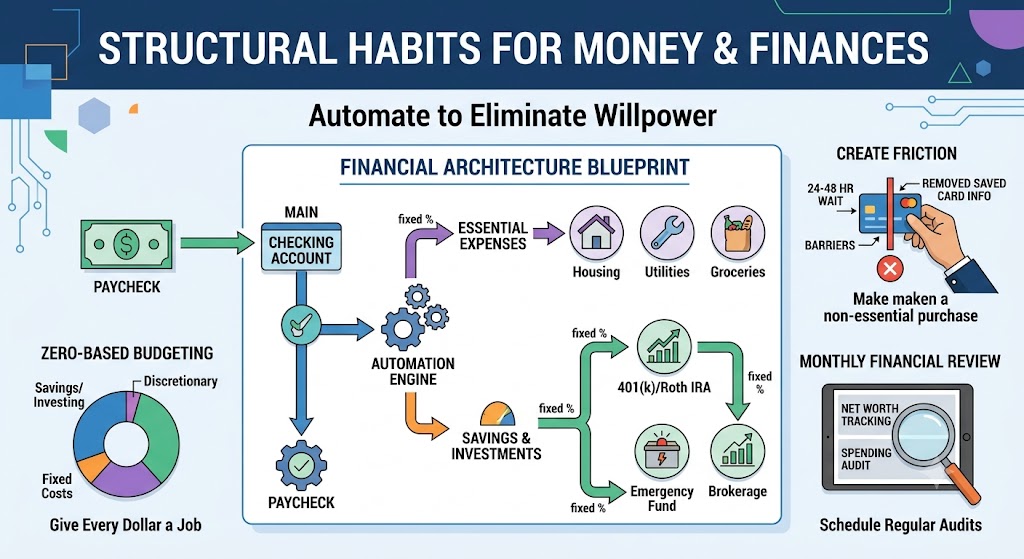
When it comes to money and finance, you can build good financial and money habits by automating your system so that good money management happens automatically. This core framework relies on automation, intentional account separation, and regular audits to remove your willpower from the equation. Below is a blueprint for a solid foundation for your money and finances.
Multiple Account Routing
Use direct deposit, direct deposit is an electronic payment method that sends funds directly into your bank account instead of through a paper check, making it faster, more secure, and environmentally friendly. By directly depositing your paycheck into your checking account and then automatically routing set percentages or fixed dollar amounts to your designated savings and investment accounts, you save time and decision fatigue. Direct deposit uses the Automated Clearing House (ACH) network to transfer money electronically from a payer (like an employer, government, or tax authority) to your bank account.
In fact, this routing approach serves as a digital sorting machine for your revenue, ensuring that every dollar is put to the best possible use as soon as it comes in. Instead of putting all of your money in a single, vulnerable pool, you create separate accounts with specific financial timelines, such as a primary checking account for immediate living expenses, a high-yield savings account for an emergency fund, and separate buckets for short-term goals like travel or annual insurance premiums. Many current payroll systems even allow you to automatically split your first direct deposit over various bank routing numbers, allowing a portion of your income to avoid your primary spending account completely.
Implementing this technique transforms your financial management from a monthly job to a self-sustaining ecosystem that ensures you always "pay yourself first." By removing the human factor from manual transfers, you reduce the incentive to spend money that might have been saved or invested. It delivers enormous psychological peace of mind; because your set expenses, future savings, and investments are paid discreetly in the background, whatever remains in your primary checking account is genuinely guilt-free discretionary income. It converts money creation from a continual willpower exercise into a smooth, automatic default state.
Zero-Based Budgeting
With zero-based budgeting, you assign every dollar a job before any money even hits your accounts. Fixed expenses like housing and utilities get funded first, followed by your savings and investing goals, and then finally your discretionary spending.
Unlike typical budgeting approaches, which just document where your money went after the fact, zero-based budgeting requires you to be conscious about your revenue ahead of time. The "zero" does not imply that your bank account is empty; rather, it indicates that your income minus your expenses (including savings) is exactly zero. By consciously designating every single dollar to a specific category, whether it's a utility payment, a retirement fund, or a weekend dinner, you avoid the mindless "leakage" that occurs when unassigned money sits quietly in a checking account.
This proactive strategy transforms your relationship with money by delivering complete clarity and control. Because every dollar has a specific purpose, you may spend on your hobbies or vacation fund without feeling guilty, knowing your expenses are paid and your future is secure. Finally, zero-based budgeting serves as a financial reality check, exposing where your priorities are and ensuring that your hard-earned money is being used properly to meet your personal objectives.
Advertisement
Automated Bill Pay and Investing
You should have automatic scheduling for all recurring bills and credit card payments to pay automatically in full every month. You should also set up a recurring transfer for investments like 401(k)s, Roth IRAs, and brokerage accounts immediately after payday so you can pay yourself for the future.
By converting these human financial tasks into a hands-off system, automation minimizes decision-making friction and shields you from your own worst spending tendencies. Instead than depending on willpower to save what is "left over" at the end of the month, automating your investments guarantees that you prioritize your long-term goals—a practice known as paying yourself first. Simultaneously, automating your bills eliminates the possibility of human error, protects your credit score from inadvertent late fines, and ensures that your fundamental commitments are easily paid without continual micromanagement.
Finally, this set-it-and-forget-it strategy restores your time and mental energy while requiring consistency in your wealth-building habit. Eliminating the daily burden of tracking due dates allows you to focus on growing your business or enjoying your hobbies. Because your payments have been made and your investment contributions are being compounded in the background, the funds remaining in your checking account are yours to spend guilt-free.
Create Friction for Your Spending
You should make impulse spending difficult by deleting credit card numbers from your web browser, instituting a 24 to 48 hour waiting period for non-essential purchases, and keeping your daily spending money in a separate checking account from your core savings accounts.
In a digital economy built for frictionless, one-click purchases, impulsive spending is primarily reliant on instant pleasure. Adding physical and digital barriers creates a critical gap between the original emotional trigger, the desire to buy, and the actual transaction. This delay disturbs the natural brain chemistry that drives impulsive spending, altering your decision-making process from quick, emotional impulses to delayed, rational reasoning. By creating little hassles, you give yourself the time you need to determine whether a purchase is aligned with your genuine long-term values or is only a fleeting whim.
Finally, building this friction serves as a behavioral guardrail that preserves your hard-earned money without needing flawless, consistent willpower. Instead of resisting temptation every time you browse a shopping website, you let the system to perform the heavy job for you. This method converts unthinking, incidental spending into purposeful, intentional choices, ensuring that your discretionary revenue is directed toward items that truly add value to your life rather than sinking into a sea of little, forgotten delivery.
Monthly Financial Review
You should do a monthly financial review each and every month. You should schedule a consistent monthly date when you do an audit of your finances. This is done to track your net worth and your monthly spending. This is to ensure you are on track with your goals, and if not, you simply adjust your budget categories as needed.
Consider this evaluation a regular health checkup for your money, rather than a duty or punishment. During this period, you will examine where each dollar went in the previous 30 days, classify your costs, and compare them to your revenue. It is also the ideal time to check that your expenses are paid, your savings objectives are accomplished, and any recurring subscriptions you no longer need are cancelled. By addressing your statistics on a daily basis, you may eliminate the worry of the unknown and replace it with complete clarity about your financial condition.
Finally, implementing this habit shifts your relationship with money from reactive to proactive. Instead of wondering where your money went at the end of the month, you direct it exactly where it should go. Over time, this persistent behavior creates a powerful historical record of your financial progress, allowing you to identify unfavorable spending tendencies before they turn into crises and celebrate minor victories as your net worth grows. It converts your long-term financial goals, like as purchasing a home, traveling, or retiring early, into a series of predictable, achievable monthly stages.
Advertisement
How Money Habits Become Structural
Over time, your daily spending patterns interact with your liquidity constraints, income cycles, and credit availability, creating a predictable outflow of items such as bills, subscriptions, and debt repayment. When people adopt these behaviors and routines of spending and saving patterns, they permanently alter the way they look at money and finances.
This structural shift occurs as a result of repeated financial decisions becoming hardwired into your lifestyle, transitioning from conscious decisions to default settings. When a habit becomes structural, it creates an unseen financial infrastructure, an automatic system of expectations and boundaries that governs how you handle every paycheck, windfall, or unforeseen bill. Your brain no longer debates whether to save a percentage of your salary or swipe a card for a luxury buy; instead, it follows the structural tracks you've put down over months and years.
Understanding this notion is extremely empowering because it allows you to consciously construct your financial architecture rather than letting passive habits do so for you. Recognizing where your present structure is leaking money or emphasizing convenience over long-term development allows you to gradually remove bad habits and replace them with better ones, such as automated investing or fixed spending restrictions. Building wealth and preserving financial stability no longer demand arduous daily willpower; instead, they become a natural result of the system you developed.
In Summery
Building structural habits for your money and finances requires automation, intentional account separation, and continuous supervision to minimize decision fatigue and impulsive behavior. Using multiple account routing and zero-based budgeting, every dollar of your income is given a task, such as supporting fixed costs and saving goals, as soon as it comes. Automating bill payments and investment contributions simplifies the process, while purposeful friction, such as deleting saved credit card data or introducing waiting periods, reduces impulse buying.
To maintain this framework, schedule a monthly financial review to evaluate your net worth, audit your spending habits, and alter your budget as appropriate. Over time, these automatic procedures combine with your income cycles and spending habits to produce a predictable cash outflow. Finally, adopting these organized habits permanently alters your connection with money, shifting financial discipline from a daily willpower challenge to a smooth, permanent method.
Back to No Fail Budgeting Guide category page to read more.
Disclaimer, Due Diligence Required: Financial markets, tax laws, and economic regulations change frequently and vary by jurisdiction. You should always perform your own independent research, complete thorough due diligence, and consult with a licensed financial advisor, certified public accountant (CPA), or legal professional before making any financial decisions or putting capital at risk. The owners and publishers of this website assume no liability for any financial losses or damages resulting from the use of this information.
Related Articles
- 16 Tricks and Tips for Living Within Your Means
- Tips for 7 Levels of Investing from Low to High Risk
- Top 15 Tricks and Tips to Saving Money on Food Away From Home
- Top 10 Tricks and Tips to Save Money on Loans
- Top 10 Common Forgotten Expenses
- Tricks and Tips to Create Financial Freedom
- Tricks and Tips to Create an Emergency Fund
- Tricks and Tips to Get Out of Debt
- Tips to Setting Up Your Budget
Advertisement
Structural Habits for Money and Finances | Tricks and Tips for Life
Comments and Questions
Please log in to leave a comment or ask a question. Don't have an account? Register here.