The Debt Snowball vs. Avalanche | Tricks and Tips for Life
The Debt Snowball vs. Avalanche | Tricks and Tips for Life
Debt snowball vs. debt avalanche: Which payoff method is right for you? Learn how to choose between quick psychological wins and maximum interest savings.
Home » Article » No Fail Budgeting Guide » The Debt Snowball Vs AvalancheThe Debt Snowball vs. Avalanche
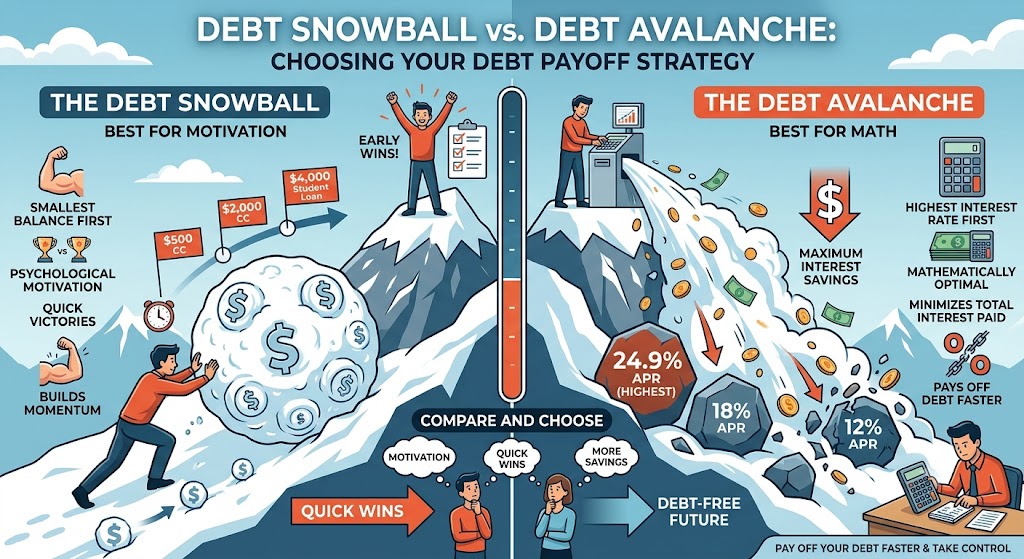
The debt snowball and debt avalanche are two tried-and-true financial strategies for eliminating debt. The snowball focuses on the smallest debt balance you have for psychological reasons, where the avalanche prioritizes the highest interest rates to save you money in the long run. Both require you to pay at least the minimum payment on all debts. The debt snowball and a debt avalanche are both ways of paying off your debts.
Choosing the appropriate path is more than simply numbers; it's also about knowing your own financial connection. While the debt avalanche is theoretically superior since it reduces the overall amount of interest you pay, the debt snowball employs behavioral psychology, providing short "wins" that keep you motivated when momentum begins to lag. Understanding these fundamental distinctions is the first step toward recovering your financial independence, as choosing a plan that fits your personality significantly boosts your chances of staying with it until you are entirely debt-free.
This guide is intended to take the mystery out of your debt-free journey by laying down the mechanics, benefits, and drawbacks of each scheme. By investigating real-world events and making step-by-step comparisons, you will obtain the knowledge required to assess your own responsibilities and choose the strategy that best suits your budget and attitude. Armed with this knowledge, you will be ready to go from feeling overwhelmed by monthly payments to implementing a clear, proactive strategy to pay off your debt for good.
The Debt Snowball: Best for Motivation
How it works: you arrange debts from smallest to greatest balance, ignoring the interest rate. You spend all your excess income on the lowest loan while paying the bare minimum on the others. When the smallest debt is entirely paid off, the payment amount is rolled into the next smallest loan. One of the benefits of this system is that it creates early wins, and this keeps you motivated. On the other hand, you pay more in interest over time.
Behavioral training is the key to the debt snowball's effectiveness. When you pay off a minor amount fast, your brain receives an immediate dopamine boost—a real "win" that demonstrates your efforts are effective. In financial planning, conduct typically takes precedence over arithmetic; if we were entirely rational calculators, we would not have gotten into debt in the first place. By focusing on little successes, the snowball approach turns a daunting, multi-year climb into a series of manageable milestones, transforming your rising momentum into a strong financial shield.
This method presents the reader with a very straightforward and well-structured roadmap. You don't have to continually evaluate changing interest rates or worry about intricate computations; your attention is always focused on a single, clearly apparent aim. As each little account's balance falls to zero, you visually clean your financial life and free up instant funds. This freed-up money is then transferred immediately to the next objective, resulting in a compounding "snowball" effect that makes you feel more powerful and in charge of your financial destiny with each passing month.
The Debt Avalanche: Best for Math
This technique is mathematically ideal, and we'll save you the most money throughout the course of paying off your debt.
How it works: you organize your debts by interest rates from the highest to the lowest. Any additional funds are channeled towards the obligation with the greatest interest rate, while all the others are paid at the minimum payment amount. Once the loan is paid off, you move to the next debt with the next highest interest rate. The biggest positive with this system is it minimizes total interest paid and helps you get out of debt faster. One of the drawbacks is it can take longer to see the first debt disappear, which requires more discipline.
The essential force of the debt avalanche is its efficiency. By targeting the debt with the highest interest rate first, you effectively eliminate the financial "leaks" that drain your hard-earned money each month. Consider high-interest debt, like as credit cards, to be a tax on your future self; the avalanche technique targets these high-cost liabilities right away, guaranteeing that every additional dollar you pay toward your debt has the most impact possible. Because you reduce the compounding interest that works against you, more of your money goes toward lowering actual principle balances rather than merely feeding the lenders.
For the reader, using this strategy results in actual, long-term savings that may be put toward your ultimate financial goals. While it takes a lot of patience and discipline to get through the first phase—especially if your highest-interest loan is also your largest balance—the return is statistically clear. This technique is ideal if you are motivated by cold, hard figures and believe that you are implementing the most cost-effective plan conceivable. Finally, the avalanche not only helps you clear your slate, but it also protects your wealth, guaranteeing that when you are debt-free, you have preserved as much money in your own pocket as possible.
Advertisement
How to Choose
If you struggle with discipline or require tiny triumphs to stay motivated, then the snowball is typically suggested. If, however, you are very disciplined and wish to reduce the overall debt amount you pay to the banks, the avalanche method is your obvious choice.
To make the best decision, look honestly at your previous financial practices rather than how you wish you had acted. Ask yourself: When faced with a long-term project, do I typically require regular, minor milestones to keep me motivated, or am I ok working toward a distant objective if I know it is the most efficient route? If you have a history of beginning budgets and then abandoning them, the debt snowball's quick psychological successes will give the behavioral boundaries you require. In contrast, if seeing needless interest charges on a spreadsheet gives you true concern, the mathematical purity of the debt avalanche will provide you with the piece of mind you need to stick with it.
Finally, the "best" strategy is just one that you can commit to completing. You may also use a hybrid technique, such as paying off one or two minor bills first for a fast motivating boost, then switching to the avalanche method to attack your highest-interest rates. Understanding that this is a personal decision rather than a rigorous guideline allows you to choose or create a strategy that is tailored to your own psychological makeup. This self-awareness eliminates the paralysis of analysis, changing your hesitancy into an immediate, concrete strategy for financial independence.
Advertisement
Real World Example
If you have
a. $5,000 at a 15% interest rate for a credit card
b. $4,000 at a 10% interest rate for a student loan
With the snowball method, you pay off (b) the $4,000 student loan first; by doing so, you would feel progress more quickly, then the $5,000 loan.
With the avalanche method, you pay off (a) the $5,000 credit card bill first, which has the highest interest rate. By using this method, you save more interest over time, but it may feel slower.
Seeing this scenario in actual figures makes the trade-off quite evident. Under the avalanche technique, prioritizing the $5,000 credit card at 15% prevents the high interest rate from accumulating quickly. If you merely pay the minimums on your credit card and focus on the lower-interest student loan, the extra interest charges on the $5,000 sum will silently pile up, costing you hundreds of dollars more over the life of your debt. Looking at the numbers, the avalanche guarantees that every extra dollar you cobble together works twice as hard to protect your wallet from the bank's highest costs.
This comparison acts as an excellent stress test for your financial personality. If you look at these two bills and feel weighed down by having many open accounts, paying off the $4,000 student loan first using the snowball method removes a complete bill out of your life quickly, leaving you with only one monthly payment to worry about. However, if staring at that 15% interest rate makes you feel like you're wasting money, the avalanche provides an obvious target to tackle first. By seeing these exact dynamics, you may firmly choose whether to purchase yourself peace of mind with a quick "win" or to save cold, hard cash through mathematical efficiency.
Bottom line: both methods work, the best choice is the one you stick with. If you can't decide how to start, then start with the snowball for a few months and then switch to the avalanche method to save you more.
Back to No Fail Budgeting Guide category page to read more.
Disclaimer, Due Diligence Required: Financial markets, tax laws, and economic regulations change frequently and vary by jurisdiction. You should always perform your own independent research, complete thorough due diligence, and consult with a licensed financial advisor, certified public accountant (CPA), or legal professional before making any financial decisions or putting capital at risk. The owners and publishers of this website assume no liability for any financial losses or damages resulting from the use of this information.
Related Articles
- 16 Tricks and Tips for Living Within Your Means
- Tips for 7 Levels of Investing from Low to High Risk
- Top 15 Tricks and Tips to Saving Money on Food Away From Home
- Top 10 Tricks and Tips to Save Money on Loans
- Top 10 Common Forgotten Expenses
- Tricks and Tips to Create Financial Freedom
- Tricks and Tips to Create an Emergency Fund
- Tricks and Tips to Get Out of Debt
- Tips to Setting Up Your Budget
Advertisement
The Debt Snowball vs. Avalanche | Tricks and Tips for Life
Comments and Questions
Please log in to leave a comment or ask a question. Don't have an account? Register here.