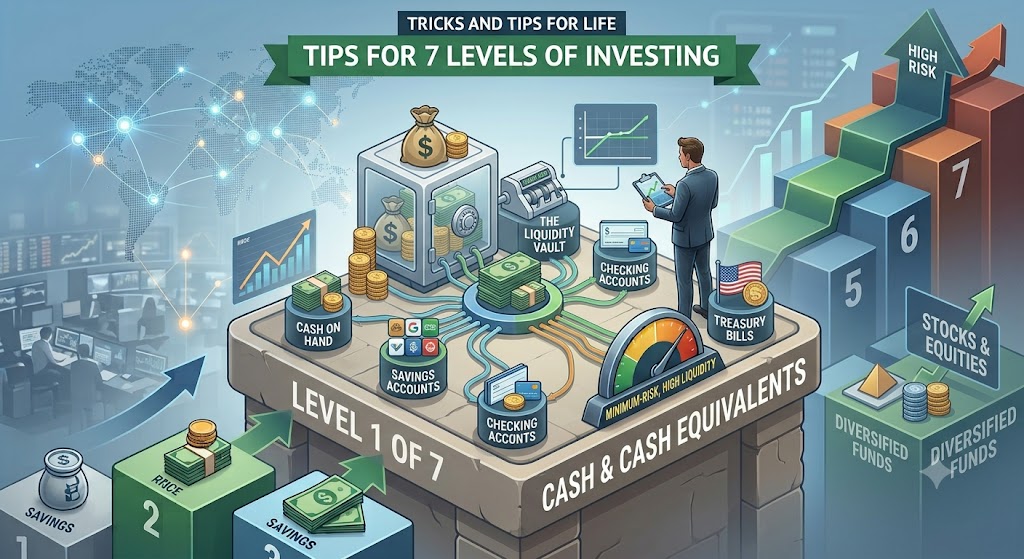
Level 1 of 7 Cash and Cash Equivalents (lowest / very low risk) | Tips for 7 Levels of Investing from Low to High Risk | Tricks and Tips for Life
Level 1 of 7 Cash and Cash Equivalents (lowest / very low risk) | Tips for 7 Levels of Investing from Low to High Risk
Master Level 1 investing with our guide to Cash and Cash Equivalents. Discover practical tips on managing low-risk savings accounts, treasury bills, and more.
Home » Article » Tips For 7 Levels Of Investing From Low To High Risk » Level 1 Of 7 Cash And Cash EquivalentsLevel 1 of 7 Cash and Cash Equivalents (lowest / very low risk)
Savings Accounts, Money Market Accounts, CDs, Treasury Bills
Cash and cash equivalents are the safest and most liquid assets you can own, as they prioritize capital preservation above rapid growth. They consist of real currency, checking and savings accounts, High-Yield Savings Accounts (HYSAs), Certificates of Deposit (CDs), and money market funds. Because these securities have short maturity dates (usually 90 days or fewer), they may be converted into real cash nearly immediately with little to no danger of losing their initial value. Individual investors find them ideal for storing an emergency fund, short-term savings objectives (such as a down payment), or dry powder waiting to be invested in the markets.
While their stability makes them an important foundation for any financial plan, they also pose a hidden risk: inflation. Because cash equivalents have relatively low interest rates, your money's buying power may decrease over time if prices grow faster than your account generates interest. For this reason, financial experts often advise holding only enough cash equivalents to satisfy your short-term requirements and emergency crises, while investing your long-term wealth in higher-yielding assets such as stocks or bonds.
7 Tips for Cash and Cash Equivalents
- Keep your emergency fund here, aim for 3 to 6 months of expenses.
- Use high-yield savings accounts instead of standard ones; the rate difference adds up.
- Make sure deposits are FDIC-insured (up to $250,000 per depositor, per bank in the US).
- Build a CD ladder to get better yields while keeping some money accessible.
- Compare APY (annual percentage yield), not just the headline interest rate.
- Remember the hidden risk: inflation can quietly erode your purchasing power even when the balance looks "safe."
- Match CD terms to when you'll actually need the money to avoid early-withdrawal penalties.
Advertisement
The aim at this stage is not expansion, but rather safety and access. Everything above is about putting your money to work; Level 1 is about ensuring that your money is there when you need it. That is the essence of what makes it the safest tier.
Principal protection means that you get back exactly what you put in. The balance does not fluctuate along with the markets.
FDIC insurance, in the United States, bank deposits are guaranteed up to $250,000 per depositor, per bank, so even if the bank fails, you don't lose your money.
Liquidity, you can access cash nearly quickly (instantly in a savings account or at maturity for a short CD), as opposed to property or private assets that take weeks or months to convert.
There is no credit or market risk, which means there is almost no threat of a "default" or crash wiping out your balance.
Even at the lowest height, the category covers a modest range:
Savings and checking accounts provide the most liquidity and safety, but the lowest yield.
Money market accounts, somewhat higher yield, but still quite safe and accessible.
CDs (certificates of deposit) offer a little higher interest in exchange for locking the money up for a specified period of time; they are safe but include early withdrawal penalties.
Treasury bills (T-bills) are short-term government debt backed by the United States government, which is about as secure as money gets.
One essential distinction to note is that Level 1 is not risk-free; rather, it exchanges one type of risk for another. The hidden concern here is the risk of inflation. If your savings earn 2% but prices rise by 3%, your money is technically increasing in value but decreasing in real purchasing power. That is the core tradeoff of the entire ladder in miniature: the safety that makes cash ideal for an emergency reserve is also what makes it a bad location to create wealth over time.
That is why cash serves a specific purpose rather than being a complete strategy, it is the solid base of the pyramid (your emergency fund and short-term necessities), but the upper layers outrun inflation and develop wealth over time.
Continue to the Next Rung of the Ladder
Investing (Level 2 of 7): Bonds and Fixed Income Investments
Disclaimer, Due Diligence Required: Financial markets, tax laws, and economic regulations change frequently and vary by jurisdiction. You should always perform your own independent research, complete thorough due diligence, and consult with a licensed financial advisor, certified public accountant (CPA), or legal professional before making any financial decisions or putting capital at risk. The owners and publishers of this website assume no liability for any financial losses or damages resulting from the use of this information.
Related Articles:
- 16 Tricks and Tips for Living Within Your Means
- Tips for 7 Levels of Investing from Low to High Risk
- Top 15 Tricks and Tips to Saving Money on Food Away From Home
- Top 10 Tricks and Tips to Save Money on Loans
- Top 10 Common Forgotten Expenses
- Tricks and Tips to Create Financial Freedom
- Tricks and Tips to Create an Emergency Fund
- Tricks and Tips to Get Out of Debt
- Tips to Setting Up Your Budget
Advertisement
Level 1 of 7 Cash and Cash Equivalents (lowest / very low risk) | Tips for 7 Levels of Investing from Low to High Risk | Tricks and Tips for Life
Comments and Questions
Please log in to leave a comment or ask a question. Don't have an account? Register here.