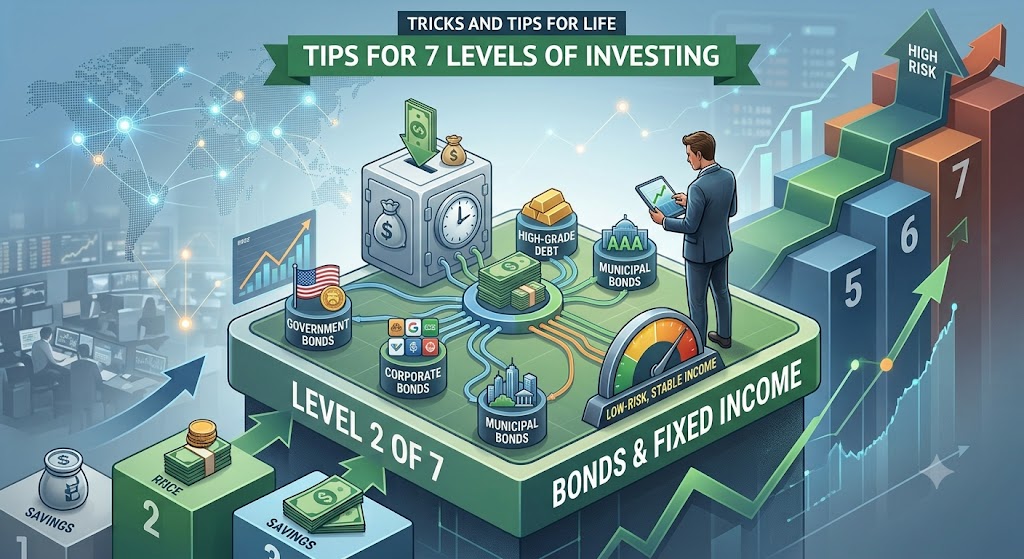
Level 2 of 7 Bonds and Fixed Income (low / low-to-moderate risk) | Tips for 7 Levels of Investing from Low to High Risk | Tricks and Tips for Life
Level 2 of 7 Bonds and Fixed Income (low / low-to-moderate risk) | Tips for 7 Levels of Investing from Low to High Risk
Master Level 2 investing with our guide to Bonds and Fixed Income. Discover essential tips and tricks to generate predictable income with lower risk.
Home » Article » Tips For 7 Levels Of Investing From Low To High Risk » Level 2 Of 7 Bonds And Fixed IncomeLevel 2 of 7 Bonds and Fixed Income (low / low-to-moderate risk)
Government, Municipal, and Corporate Bonds
Bonds and fixed-income investments serve as loans made to an issuer, such as a firm, municipality, or the federal government. In exchange for your capital, the issuer undertakes to pay you regular, set interest payments, known as coupon payments, over a defined duration, as well as the complete return of your initial investment when the bond matures. Fixed-income assets play an important stabilizing role in an investment portfolio since their distribution schedules are legally required and very predictable. They are generally utilized by investors to provide a consistent stream of passive income and to protect the entire portfolio from the stock market's wild fluctuations.
Bonds are typically safer than stocks, although they are not completely risk-free. Their biggest hazard is interest rate risk: as market interest rates rise, freshly issued bonds provide larger payments, causing the resale value of lower-rate bonds to fall. In addition, investors must consider inflation risk, which can reduce the buying power of fixed payments, and default risk, which is the possibility that the issuer would fail to make payments. To mitigate these risks, fixed-income investments range from ultra-safe US Treasuries to higher-yielding, higher-risk "junk bonds" issued by financially troubled corporations.
7 Tips for Bonds and Fixed Income Investing
- Treasuries (government bonds) are the safest; corporate bonds pay more but carry more risk.
- Learn the key relationship: when interest rates rise, existing bond prices fall, and vice versa.
- Check credit ratings, AAA is top quality, while "junk" bonds pay high yields for high risk.
- Use bond funds or ETFs for instant diversification rather than buying individual bonds.
- Consider municipal bonds for potential tax advantages, especially in higher tax brackets.
- Match a bond's duration to your time horizon to reduce interest-rate risk.
- Look at TIPS (Treasury Inflation-Protected Securities) if inflation is a concern.
Advertisement
It's the natural next rung up from cash: still considered conservative and relatively safe, but with a bit more risk than Level 1 in exchange for typically higher returns.
The step up in risk comes mainly from two sources that cash equivalents don't really have:
Interest-rate risk, if rates rise, the market value of your existing bonds falls.
Credit/default risk, the borrower could fail to pay you back (very low for Treasuries, higher for corporate and "junk" bonds).
Remember that "Bonds and Fixed Income" is a range rather than a single risk point. A short-term US Treasury is just slightly riskier than cash, but a long-term high-yield ("junk") corporate bond might carry risk closer to stocks. So Level 2 is a "low risk" category, but where a bond falls relies heavily on its issuer and term.
Continue to the Next Rung of the Ladder
Investing (Level 3 of 7): Diversified Funds
Disclaimer, Due Diligence Required: Financial markets, tax laws, and economic regulations change frequently and vary by jurisdiction. You should always perform your own independent research, complete thorough due diligence, and consult with a licensed financial advisor, certified public accountant (CPA), or legal professional before making any financial decisions or putting capital at risk. The owners and publishers of this website assume no liability for any financial losses or damages resulting from the use of this information.
Related Articles:
- 16 Tricks and Tips for Living Within Your Means
- Tips for 7 Levels of Investing from Low to High Risk
- Top 15 Tricks and Tips to Saving Money on Food Away From Home
- Top 10 Tricks and Tips to Save Money on Loans
- Top 10 Common Forgotten Expenses
- Tricks and Tips to Create Financial Freedom
- Tricks and Tips to Create an Emergency Fund
- Tricks and Tips to Get Out of Debt
- Tips to Setting Up Your Budget
Advertisement
Level 2 of 7 Bonds and Fixed Income (low / low-to-moderate risk) | Tips for 7 Levels of Investing from Low to High Risk | Tricks and Tips for Life
Comments and Questions
Please log in to leave a comment or ask a question. Don't have an account? Register here.