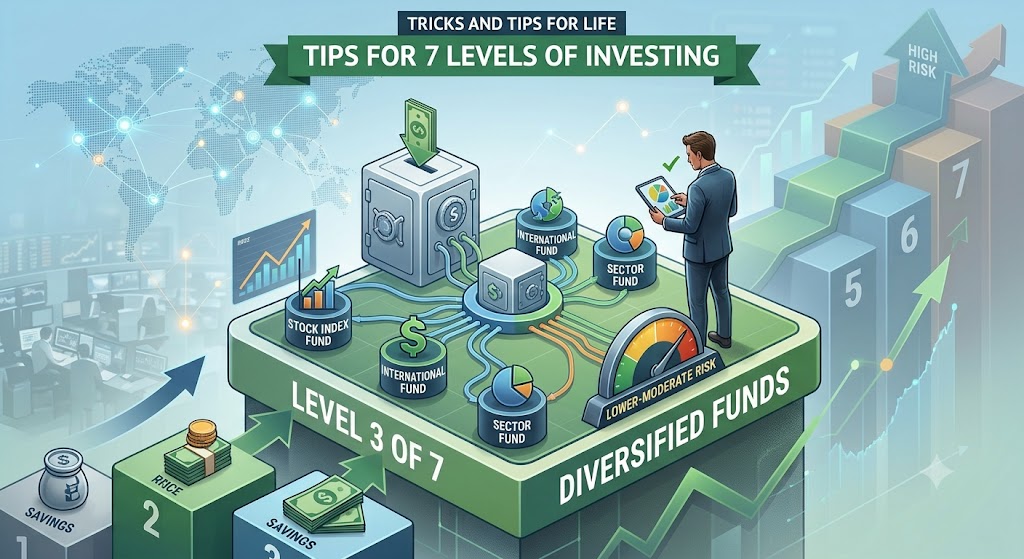
Level 3 of 7 Diversified Funds (low-to-moderate / moderate risk) | Tips for 7 Levels of Investing from Low to High Risk | Tricks and Tips for Life
Level 3 of 7 Diversified Funds (low-to-moderate / moderate risk) | Tips for 7 Levels of Investing from Low to High Risk
Master Level 3 of investing: Index Funds, ETFs, Mutual Funds, Target-Date Funds. Build a diversified portfolio with tips for each fund type.
Home » Article » Tips For 7 Levels Of Investing From Low To High Risk » Level 3 Of 7 Diversified FundsLevel 3 of 7 Diversified Funds (low-to-moderate / moderate risk)
Index Funds, ETFs, Mutual Funds, Target-Date Funds
Diversified funds, such as mutual funds and exchange-traded funds (ETFs), combine money from thousands of participants to purchase a large, prepackaged portfolio of various assets. Instead of risking your money on a few individual stocks or bonds, a single share of a diversified fund may provide you with fractional ownership in hundreds, if not thousands, of underlying firms across several industries and locations. This approach is based on the basic notion of "not putting all your eggs in one basket." By spreading your money so thinly, a catastrophic drop in one company's stock price is securely buffered by the stability or growth of the fund's other assets, thus minimizing your overall investment risk.
The key trade-off when selecting these funds is the management style and charge structures. Mutual funds are frequently actively managed by specialists who select specific investments that beat the market, resulting in higher management costs (expense ratios). In contrast, ETFs and index funds often track a certain market benchmark (such as the S&P 500) passively, resulting in ultra-low costs and greater tax efficiency. Regardless of form, diversified funds are largely regarded as the most practical, hands-off vehicle for regular investors to capitalize on the global economy's long-term development without the time or skill required to manage an individual portfolio.
8 Tips for Investing in Diversified Funds
- Favor low-cost index funds for broad market exposure without stock-picking.
- Scrutinize expense ratios, even 1% in fees compounds into a large drag over decades.
- Use dollar-cost averaging (investing a fixed amount regularly) to smooth out market swings.
- Consider target-date funds, which automatically shift toward safer assets as you age.
- Prefer ETFs for intraday trading flexibility and often better tax efficiency.
- Diversify across sectors and geographies, not just one country or industry.
- Reinvest dividends to take full advantage of compounding.
- Be skeptical of expensive actively managed funds, most don't beat their index over time.
Advertisement
This is when you begin to go from "conservative" to actual growth area. The reason it lies above bonds but below individual equities boils down to one word: diversity. A fund mitigates the impact of a single failure by spreading your money over hundreds or thousands of holdings, but the basket as a whole still rises and falls in tandem with the markets it monitors.
The problematic thing about this level is that its risk isn't fixed, it completely relies on what's within the fund.
A bond index fund operates similarly to Level 2 (low risk).
A balanced or target-date fund (a combination of equities and bonds) falls solidly in the low-to-moderate range.
A total stock market or S&P 500 index fund has roughly the same market risk as Level 4 stocks, diversification protects you against one firm failing, but not from a wide market slump.
The main advantage of Level 3 is that it allows you to catch much of the growth of higher levels while eliminating one of the most terrifying risks: the possibility that a single bad decision may wipe out your whole investment. That's why diversified funds are frequently advised as the foundation of a long-term portfolio.
Continue to the Next Rung of the Ladder
Investing (Level 4 of 7): Stocks and Equities
Disclaimer, Due Diligence Required: Financial markets, tax laws, and economic regulations change frequently and vary by jurisdiction. You should always perform your own independent research, complete thorough due diligence, and consult with a licensed financial advisor, certified public accountant (CPA), or legal professional before making any financial decisions or putting capital at risk. The owners and publishers of this website assume no liability for any financial losses or damages resulting from the use of this information.
Related Articles:
- 16 Tricks and Tips for Living Within Your Means
- Tips for 7 Levels of Investing from Low to High Risk
- Top 15 Tricks and Tips to Saving Money on Food Away From Home
- Top 10 Tricks and Tips to Save Money on Loans
- Top 10 Common Forgotten Expenses
- Tricks and Tips to Create Financial Freedom
- Tricks and Tips to Create an Emergency Fund
- Tricks and Tips to Get Out of Debt
- Tips to Setting Up Your Budget
Advertisement
Level 3 of 7 Diversified Funds (low-to-moderate / moderate risk) | Tips for 7 Levels of Investing from Low to High Risk | Tricks and Tips for Life
Comments and Questions
Please log in to leave a comment or ask a question. Don't have an account? Register here.