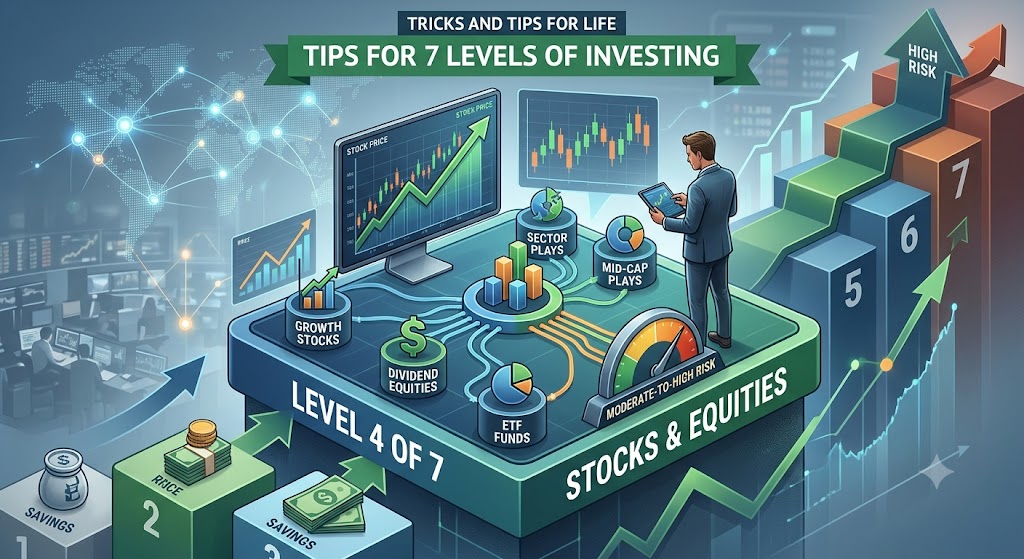
Level 4 of 7 Stocks and Equities (moderate-to-high risk) | Tips for 7 Levels of Investing from Low to High Risk | Tricks and Tips for Life
Level 4 of 7 Stocks and Equities (moderate-to-high risk) | Tips for 7 Levels of Investing from Low to High Risk
Master Level 4 of investing: Stocks and Equities. Discover practical tips and tricks to navigate moderate-to-high risk investments and grow your wealth.
Home » Article » Tips For 7 Levels Of Investing From Low To High Risk » Level 4 Of 7 Stocks And EquitiesLevel 4 of 7 Stocks and Equities (moderate-to-high risk)
Individual company shares
Stocks and equities reflect fractional ownership of a company. When you acquire a share of a firm, you become a shareholder, which means you own a little portion of the company's assets and potential revenues. Investors buy stocks largely because of their unrivaled potential for long-term compounding gain, making them the driving force behind most wealth-building portfolios. You can earn in two ways: through capital appreciation (selling the stock for more than you purchased) and dividends (a percentage of the company's income distributed on a regular basis to shareholders). Stock prices are more volatile and risky than bonds or cash since they move every second based on corporate performance, economic news, and investor mood.
Over time, however, historical evidence suggests that a diverse portfolio of equities beats inflation and nearly every other major asset class. To mitigate the inherent dangers of the stock market, investors often divide their portfolios between stable, established "blue-chip" corporations that pay consistent dividends and fast-growing tech or rising companies that reinvest their earnings to develop. Whether you invest in individual firms or utilize funds to buy the entire market, stocks are critical for increasing long-term buying power and meeting distant financial milestones such as retirement.
8 Tips for Investing in Stocks and Equities
- Diversify avoid putting too large a share of your money in any single stock.
- Think long-term; "time in the market" generally beats trying to time the market.
- Understand the difference between stable dividend/blue-chip stocks and volatile growth or small-cap stocks.
- Research fundamentals like earnings, debt levels, and valuation ratios before buying.
- Don't panic-sell during downturns or chase stocks during euphoria, emotions are costly.
- Have a clear plan for why you own each stock and when you'd sell.
- Be honest about your risk tolerance; stocks suit money you won't need for years.
- Watch out for concentration through your employer's stock plus stock options.
Advertisement
This is the point at which you truly transition into growth investing and begin to feel the daily ups and downs. The increase in risk from Level 3 is due to concentration. When you hold individual stocks, your fortune is dependent on a single company's earnings, management, competition, and luck. There is no basket of hundreds of other stocks to soften the damage if that one firm fails.
The risk within this level varies quite a bit depending on what kind of stock you own:
Blue-chip / dividend stocks (big, established corporations) are on the lower end, more stable, and frequently pay consistent dividends.
Growth stocks (businesses that reinvest for quick expansion) swing harder in both directions.
Small-cap and speculative equities are on the leading edge, occasionally nearing Level 7 volatility.
However, the tradeoff is real: historically, equities have produced the highest long-term returns of any popular asset class. The drawback is that such gains come with volatility, it's very typical for a company, or even the entire market, to fall 20-30% or more in a terrible year. That is why equities are appropriate for long-term investments; time allows you to ride out losses and capitalize on gains.
One distinction worth noting: a single stock is riskier than a diversified stock fund, despite the fact that both are "equities." Level 3's S&P 500 index fund invests in 500 firms; each share of one of these companies involves the same market risk as well as company-specific risk. So the transition from Level 3 to Level 4 is essentially from "owning the market" to "owning a piece of it."
Continue to the Next Rung of the Ladder
Investing (Level 5 of 7): Real Estate Investments
Disclaimer, Due Diligence Required: Financial markets, tax laws, and economic regulations change frequently and vary by jurisdiction. You should always perform your own independent research, complete thorough due diligence, and consult with a licensed financial advisor, certified public accountant (CPA), or legal professional before making any financial decisions or putting capital at risk. The owners and publishers of this website assume no liability for any financial losses or damages resulting from the use of this information.
Related Articles:
- 16 Tricks and Tips for Living Within Your Means
- Tips for 7 Levels of Investing from Low to High Risk
- Top 15 Tricks and Tips to Saving Money on Food Away From Home
- Top 10 Tricks and Tips to Save Money on Loans
- Top 10 Common Forgotten Expenses
- Tricks and Tips to Create Financial Freedom
- Tricks and Tips to Create an Emergency Fund
- Tricks and Tips to Get Out of Debt
- Tips to Setting Up Your Budget
Advertisement
Level 4 of 7 Stocks and Equities (moderate-to-high risk) | Tips for 7 Levels of Investing from Low to High Risk | Tricks and Tips for Life
Comments and Questions
Please log in to leave a comment or ask a question. Don't have an account? Register here.