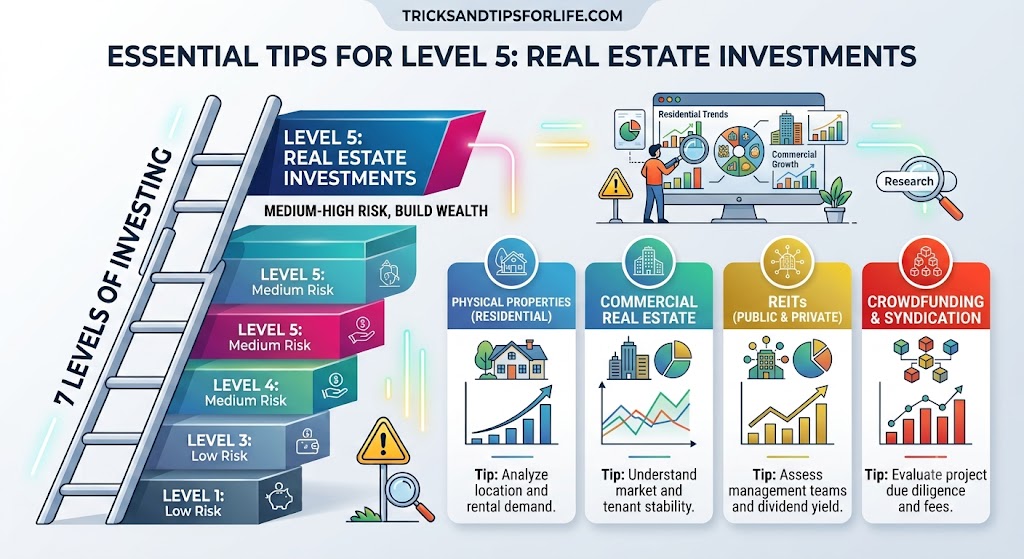
Level 5 of 7 Real Estate Investments (moderate-to-high risk) | Tips for 7 Levels of Investing from Low to High Risk | Tricks and Tips for Life
Level 5 of 7 Real Estate Investments (moderate-to-high risk) | Tips for 7 Levels of Investing from Low to High Risk
Explore Level 5 of the risk ladder. Get essential tips on building wealth through real estate investments, including physical property, REITs, and crowdfunding.
Home » Article » Tips For 7 Levels Of Investing From Low To High Risk » Level 5 Of 7 Real Estate InvestmentsLevel 5 of 7 Real Estate Investments (moderate-to-high risk)
Rental property, REITs, real estate funds
Real estate investing is the process of acquiring physical property or real estate assets in order to build wealth through rental income and capital appreciation. Unlike stocks and bonds, physical real estate is a tangible asset that allows investors to leverage, that is, utilize a bank's money (a mortgage) to acquire a high-value asset with a modest down payment. This can considerably increase your earnings if the property's value rises. Real estate is an effective inflation hedge since property values and rents often grow in tandem with the overall cost of living. It generates a consistent, predictable stream of monthly passive income flow while also increasing long-term value as the mortgage is paid down.
However, physical real estate has unique issues, such as high initial capital requirements, continuous maintenance expenses, property management headaches, and illiquidity, which means it might take months to sell and convert into cash. Real Estate Investment Trusts (REITs) provide an appealing alternative for investors seeking property exposure without the hassles of owning a rental property. REITs are corporations that own, operate, or finance income-producing real estate; they trade on public stock markets like conventional shares and are legally obligated to pay out at least 90% of their taxable revenue to shareholders in dividends. This makes real estate affordable to people of all income levels and risk profiles.
7 Tips for Real Estate Investing
- Location is the single biggest driver of long-term value.
- Budget for all costs, property taxes, maintenance, insurance, and vacancy periods.
- Use REITs if you want real estate exposure without owning or managing property.
- Respect leverage: a mortgage amplifies both your gains and your losses.
- Plan for illiquidity, property can take months to sell, unlike stocks.
- Factor in property management costs if you won't handle tenants yourself.
- Study local market cycles rather than assuming prices only go up.
Advertisement
What's interesting about this level is that it sits at a similar height to Level 4, yet the risks come from almost entirely different sources. Stocks and real estate often don't move in sync, which is exactly why people add property to a portfolio, it can zig when stocks zag.
The risk here is driven by a distinct set of factors:
Illiquidity, a house cannot be sold in an afternoon in the same manner that a stock can. A transaction might take weeks or months, and you may need to lower your price to sell it.
Leverage, most real estate is purchased with a mortgage, which multiplies both earnings and losses. With a 20% down payment, a 10% increase in value equals a 50% increase in cash, but a 10% decrease reduces your equity in half just as quickly.
Concentration and expense, a single property is a huge, undiversified gamble with taxes, upkeep, insurance, and vacancy gaps that reduce returns.
As with preceding levels, the risk varies greatly depending on how you invest:
REITs (real estate investment trusts) are in the lower-to-middle range, they trade like stocks, are diversified across several properties, and are simple to acquire and sell. The trade-off is that they are more sensitive to the stock market than real property.
Real estate funds are in the middle, diverse but generally less liquid than REITs.
Direct rental property is on the leading edge, with the most control and possible profit, but also the most leverage, illiquidity, and hands-on risk (poor renters, unexpected repairs, and a market that is difficult to escape fast).
The appeal is that real estate may provide returns in two ways: continuous rental income and long-term appreciation, and it has traditionally been a good inflation hedge, since rents and property values tend to grow with prices.
One point to note: there is a significant risk gap within this single level. A REIT maintained in your brokerage account operates similarly to a Level 3-4 stock fund, liquid and diverse. A single leveraged rental property is a significantly more focused, hands-on, difficult-to-exit commitment that can approach Level 6 status. So the term "real estate" has a broader risk range than virtually any other level on the ladder, depending on whether you own property shares or the property itself.
Continue to the Next Rung of the Ladder
Investing (Level 6 of 7): Alternative Investments
Disclaimer, Due Diligence Required: Financial markets, tax laws, and economic regulations change frequently and vary by jurisdiction. You should always perform your own independent research, complete thorough due diligence, and consult with a licensed financial advisor, certified public accountant (CPA), or legal professional before making any financial decisions or putting capital at risk. The owners and publishers of this website assume no liability for any financial losses or damages resulting from the use of this information.
Related Articles:
- 16 Tricks and Tips for Living Within Your Means
- Tips for 7 Levels of Investing from Low to High Risk
- Top 15 Tricks and Tips to Saving Money on Food Away From Home
- Top 10 Tricks and Tips to Save Money on Loans
- Top 10 Common Forgotten Expenses
- Tricks and Tips to Create Financial Freedom
- Tricks and Tips to Create an Emergency Fund
- Tricks and Tips to Get Out of Debt
- Tips to Setting Up Your Budget
Advertisement
Level 5 of 7 Real Estate Investments (moderate-to-high risk) | Tips for 7 Levels of Investing from Low to High Risk | Tricks and Tips for Life
Comments and Questions
Please log in to leave a comment or ask a question. Don't have an account? Register here.